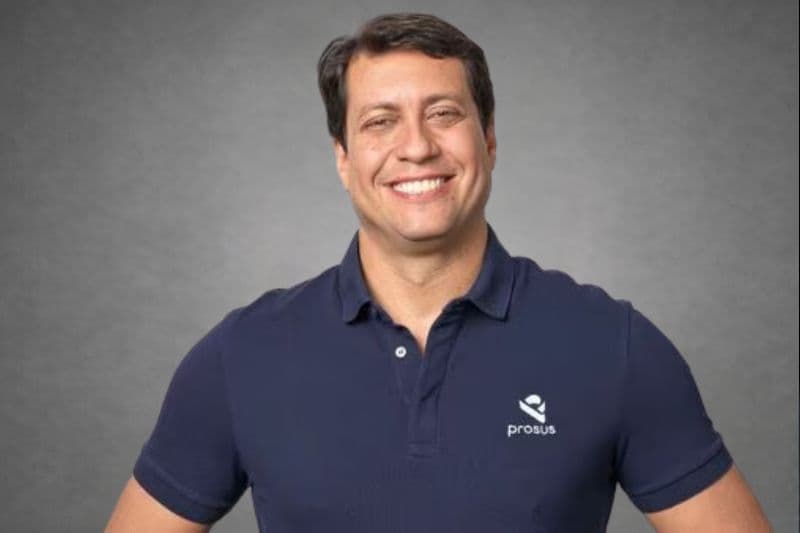
Fabricio-Bloisi, CEO at Prosus and Naspers
4.5/5 Rating
Technology
$1M+/mo
Approximately $6B+ USD ARR

Fabricio-BloisiCEO

In this interview, Prosus CEO Fabricio Bloisi shares how he built billion-dollar technology businesses through relentless innovation, strong culture, and entrepreneurial leadership. He discusses scaling iFood, creating technology ecosystems across Latin America, India, and Europe, and why AI will transform companies faster than most people expect.

Fabricio-Bloisi

Fabricio-Bloisi

CEO

Prosus and Naspers

Prosus and Naspers

Founder Stats

  • Technology
  • Started 1997
  • $1M+/mo
  • 10,000+ team
  • Amsterdam, Netherlands

About Fabricio-Bloisi

Fabricio Bloisi is the CEO of Prosus, a global technology company operating across food delivery, fintech, e-commerce, and lifestyle services. After building iFood into one of the world's leading food delivery platforms, he now leads Prosus' mission to create AI-driven technology ecosystems across multiple continents.

Interview

June 6,2026

Q

What is Prosus and what makes it different?

Question 1 of 18
Fabricio-Bloisi

Prosus is a technology company serving more than a billion people through food delivery, payments, travel, and lifestyle services. What makes us different is that we are not passive investors. We build operational technology businesses and connect them into ecosystems where companies help each other grow through innovation, AI, culture, and execution.

0
Q

What is your long-term vision for Prosus?

Question 2 of 18
Fabricio-Bloisi

My vision is to build technology ecosystems in Latin America, India, and Europe. We have already proven the model in Latin America. Now we are replicating it across other regions, creating companies that work together and use technology, AI, and customer data to serve people better.

0
Q

Why are you so excited about India?

Question 3 of 18
Fabricio-Bloisi

India reminds me of China many years ago when we first invested there. It has a huge market, incredible entrepreneurial energy, and enormous growth potential. I believe the next decade in India will create some of the world's most important technology companies.

0
Q

You spent years failing before succeeding. Why didn't you quit?

Question 4 of 18
Fabricio-Bloisi

I loved what I was doing. Failure was part of learning. Every year we became a little better, learned more about culture, management, innovation, and people. Even when we had very little money, we focused on building a stronger company and finding better people.

0
Q

What is the biggest lesson from building a company from scratch?

Question 5 of 18
Fabricio-Bloisi

The biggest lesson is that success comes from people. My job is not to be the smartest person in the room. My job is to find people who are better than me, give them a big vision, and create an environment where they can do extraordinary things.

0
Q

How did you turn iFood into a massive business?

Question 6 of 18
Fabricio-Bloisi

We acquired iFood when it was very small. Then we added culture, innovation, strong management, and ambitious goals. The company grew from around 20,000 orders per month to around 200 million orders per month. That growth came from execution, learning, and constant improvement.

0
Q

What advice would you give entrepreneurs who want to build something big?

Question 7 of 18
Fabricio-Bloisi

Think much bigger than feels comfortable. Most people underestimate what is possible. If you combine ambitious goals with outstanding people and relentless execution, you can achieve far more than you initially believe.

0
Q

How do you identify exceptional talent?

Question 8 of 18
Fabricio-Bloisi

I look for people who are comfortable with uncertainty and big challenges. I want entrepreneurs who want impact, ownership, and responsibility. I empower them to make decisions, but I also understand that sometimes people are not the right fit and difficult decisions need to be made.

0
Q

What is the key to innovation?

Question 9 of 18
Fabricio-Bloisi

Innovation starts with never being satisfied. Even when things are working well, we ask how to make them better. We challenge ourselves every day. The pressure to improve, experiment, and reinvent is constant throughout the company.

0
Q

What are "jet skis" inside your organization?

Question 10 of 18
Fabricio-Bloisi

Jet skis are small entrepreneurial teams that operate like startups inside a large company. Instead of spending huge budgets upfront, they experiment quickly, fail often, test ideas, and discover what works. Once something succeeds, we scale it across the organization.

0
Q

What does it mean to build an ambidextrous organization?

Question 11 of 18
Fabricio-Bloisi

It means combining innovation and discipline. Companies need entrepreneurs who challenge the status quo, but they also need managers who can scale and execute. If you only have discipline, you become slow. If you only have creativity, you struggle to grow.

0
Q

How has AI changed the way you operate?

Question 12 of 18
Fabricio-Bloisi

AI is transforming every part of our business. It powers personalization, customer engagement, fraud prevention, and operations. We are also giving AI tools to employees so they can build agents and automate parts of their work. The impact on productivity is already significant.

0
Q

Do you think AI is overhyped or underhyped?

Question 13 of 18
Fabricio-Bloisi

AI is underhyped. The pace of change over the last few months has exceeded expectations. What companies can do today was not possible just a short time ago. Many people still underestimate how quickly AI will transform organizations.

0
Q

How will AI change companies over the next few years?

Question 14 of 18
Fabricio-Bloisi

Companies will become far more autonomous. AI will not simply make individuals faster. It will make entire organizations dramatically more efficient. Businesses that adopt these capabilities early will gain significant advantages over competitors.

0
Q

How do you spread innovation across such a large organization?

Question 15 of 18
Fabricio-Bloisi

That is one of my most important responsibilities. We bring leaders together frequently, share what is working, and encourage teams to copy successful ideas. If we discover something valuable in Amsterdam, I want teams in Brazil and India learning from it immediately.

0
Q

How do you build the same culture across multiple continents?

Question 16 of 18
Fabricio-Bloisi

We communicate constantly. We have a very clear strategy, frequent company-wide updates, and a high level of transparency. People know what is working, what is failing, and what we need to improve. That openness helps create an entrepreneurial culture everywhere.

0
Q

What role does culture play in business success?

Question 17 of 18
Fabricio-Bloisi

Culture is everything. Results come from culture. When you empower the right people, encourage innovation, focus on execution, and create accountability, great results follow naturally. I spend more time talking about culture than financial results.

0
Q

What advice would you give young people today?

Question 18 of 18
Fabricio-Bloisi

Dream big. The world is going to change dramatically over the next few years. Many opportunities that seem impossible today will become possible tomorrow. Learn constantly, pursue something you are passionate about, and believe you can help build the future.

0

Video Interviews with Fabricio-Bloisi

Prosus CEO: Why AI Is Still Under-hyped and What to Do About It | Podcast | In Good Company

Prosus CEO: Why AI Is Still Under-hyped and What to Do About It | Podcast | In Good Company
Prosus CEO: Why AI Is Still Under-hyped and What to Do About It | Podcast | In Good Company

The Next Trillion-Dollar Company Won’t Come From Silicon Valley | Prosus CEO Fabricio Bloisi

The Next Trillion-Dollar Company Won’t Come From Silicon Valley | Prosus CEO Fabricio Bloisi

How Prosus’ CEO Builds a Winning Tech Culture | Fabricio Bloisi

How Prosus’ CEO Builds a Winning Tech Culture | Fabricio Bloisi

Young Turks Reloaded In Davos | India, A.I. & The New Global Order

Young Turks Reloaded In Davos | India, A.I. & The New Global Order

Cite This Interview

Use this interview in your research, article, or academic work