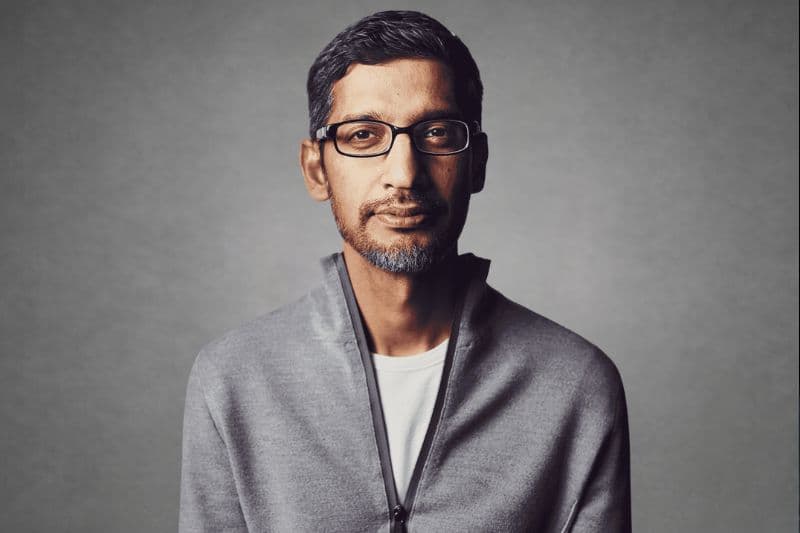
Pichai Sundararajan, CEO at Google
4.9/5 Rating
Technology
$1M+/mo
Approximately $350+ Billion USD ARR

Pichai SundararajanCEO

In this interview, Google and Alphabet CEO Sundar Pichai discusses how AI is reshaping Google, search, software development, and the future of work. He shares his leadership approach, explains Google's AI strategy, reflects on organizational change, and offers his perspective on AGI, innovation, and the responsibilities that come with building one of the world's most influential technologies.

Pichai Sundararajan

Pichai Sundararajan

CEO

Google

Google

Founder Stats

  • Technology
  • Started 2015 or
  • $1M+/mo
  • 50+ team
  • USA

About Pichai Sundararajan

Sundar Pichai is the CEO of Google and Alphabet. Since joining Google in 2004, he has helped lead products including Chrome, Android, and Search, and now oversees Google's transformation into an AI-first company while guiding its long-term technology strategy.

Interview

9 June, 2026

Q

How do you think about Google's structure today?

Question 1 of 15
Pichai Sundararajan

I think about Google through a few major pillars. Search, YouTube, and Google Cloud are our core businesses. Then we have large computing platforms like Android and Chrome. Underneath all of it is our AI and infrastructure work, which increasingly powers everything we build across the company.

0
Q

How has AI changed the way Google operates?

Question 2 of 15
Pichai Sundararajan

AI has created a common foundation across many of our products. For the first time, we can build intelligence once and apply it across Search, Maps, Gemini, and other products. That allows us to be much more intentional and coordinated in how we innovate and serve users.

0
Q

What did the ChatGPT moment teach you as a leader?

Question 3 of 15
Pichai Sundararajan

It reinforced that we needed to move faster. I felt we already had many of the core ingredients, but the market was changing more quickly than expected. That pushed us to reorganize teams, centralize AI efforts, and create structures that allowed us to make decisions and ship products faster.

0
Q

What is your approach to making decisions?

Question 4 of 15
Pichai Sundararajan

Most decisions are not as consequential as people think. What matters is making them. Organizations lose momentum when decisions are delayed. The truly important decisions deserve careful consideration, but for many others, speed and execution matter more than trying to find perfection.

0
Q

How do you know when a decision deserves extra attention?

Question 5 of 15
Pichai Sundararajan

Experience helps. Over time, you develop pattern recognition and intuition. You learn to separate signal from noise. Some decisions fundamentally change the direction of the company, while others are simply part of normal execution. Knowing the difference is an important leadership skill.

0
Q

What role do leaders play in an AI-driven company?

Question 6 of 15
Pichai Sundararajan

Great leaders remain incredibly important. Technology can improve efficiency, but people still provide vision, judgment, and accountability. Different organizations require different structures, but I don't see leadership becoming less important. If anything, leaders become more important as technology becomes more powerful.

0
Q

How is AI changing the way employees work?

Question 7 of 15
Pichai Sundararajan

We are already seeing employees move beyond using AI as an assistant. Many developers are beginning to direct teams of AI agents that help them accomplish tasks. That shift will likely spread into many other parts of organizations over time.

0
Q

Could AI eventually replace CEOs?

Question 8 of 15
Pichai Sundararajan

Some aspects of the CEO role could certainly be improved by AI. It may help with decision-making and resource allocation. But I think AI is more likely to elevate what leaders can accomplish rather than replace them entirely. It raises the foundation from which people work.

0
Q

How do you think about the future of AI agents?

Question 9 of 15
Pichai Sundararajan

Agents are becoming one of the most important developments in AI. The ability to reason, use tools, plan tasks, and build solutions creates a powerful foundation. We are putting many of these capabilities into place today, and over time they will feel much more seamless to users.

0
Q

What is your vision for Google's AI assistant?

Question 10 of 15
Pichai Sundararajan

For years, the industry has talked about intelligent assistants that truly help people. I believe we are closer than ever to making that vision real. We have not fully achieved it yet, but the technology is finally reaching a point where it can deliver meaningful assistance.

0
Q

Why do you think many people feel anxious about AI?

Question 11 of 15
Pichai Sundararajan

AI is moving very quickly and affecting many parts of society at once. People are naturally concerned about jobs, energy use, misinformation, and economic change. Those concerns are understandable. We should listen carefully and treat them seriously rather than dismissing them.

0
Q

Is public concern about AI just a marketing problem?

Question 12 of 15
Pichai Sundararajan

No. I think the concerns are deeper than that. People are trying to understand what this technology means for their future. Questions about work, education, energy, and society are legitimate concerns. These are issues we need to address collectively as an industry and as a society.

0
Q

What responsibility do technology companies have as AI advances?

Question 13 of 15
Pichai Sundararajan

We have a responsibility to address challenges proactively. That includes topics like deepfakes, cybersecurity, workforce adaptation, and energy usage. Public participation matters too. A technology this important should not evolve without meaningful involvement from society.

0
Q

How do you see the future of the web?

Question 14 of 15
Pichai Sundararajan

I remain optimistic. The web has always evolved and adapted. People want to create, share information, and connect with others. AI and agents represent another stage of that evolution. The web will change, but I believe it will continue to play a central role in people's lives.

0
Q

What does it mean to be in the "foothills of the singularity"?

Question 15 of 15
Pichai Sundararajan

In this context, it means we are approaching systems that become increasingly capable across a wide range of cognitive tasks. The technology is advancing very rapidly, and many researchers believe these breakthroughs are arriving sooner rather than later.

0

Video Interviews with Pichai Sundararajan

How Sundar Pichai is rethinking Google for the AI era | Decoder

How Sundar Pichai is rethinking Google for the AI era | Decoder

How Sundar Pichai is rethinking Google for the AI era | Decoder

AGI in 3 or 5 Years No Longer Matters — Pichai Lays Google's Cards Bare | The Verge Interview
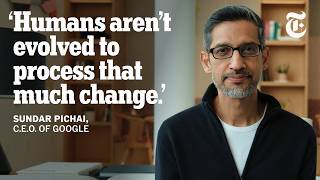
AGI in 3 or 5 Years No Longer Matters — Pichai Lays Google's Cards Bare | The Verge Interview

Sundar Pichai on A.I. Backlash, the Future of Work and Google’s Next Era
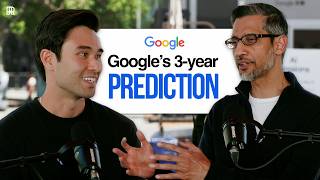
Sundar Pichai on A.I. Backlash, the Future of Work and Google’s Next Era

Sundar Pichai on Agents Replacing Engineers, Google's Future, AI's Flip Phone Moment, and More

Sundar Pichai on Agents Replacing Engineers, Google's Future, AI's Flip Phone Moment, and More

Cite This Interview

Use this interview in your research, article, or academic work