
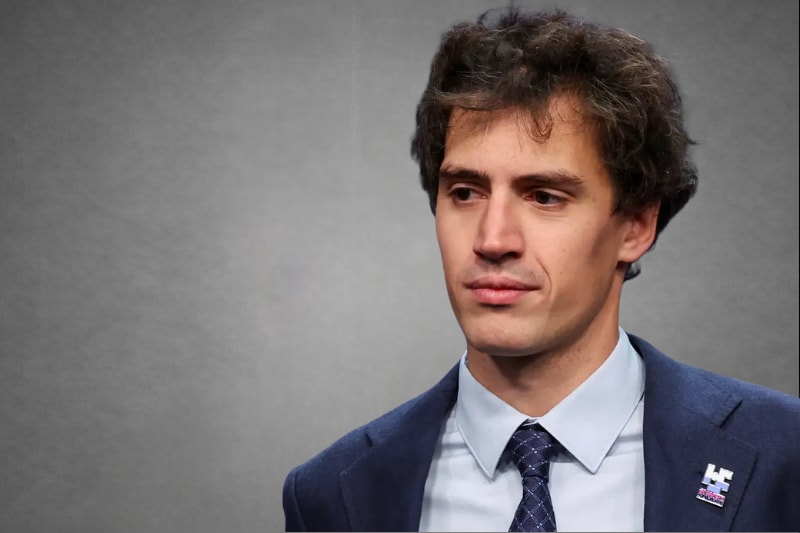
Arthur MenschCo-Founder & CEOSovereign AI frontier models and enterprise compute economics
In this interview, Arthur Mensch, Co-Founder and Chief Executive Officer of Mistral AI, analyzes the geopolitical and economic dynamics driving the global artificial intelligence race. Drawing from his pioneering research at DeepMind, he examines open-weight architectural efficiency, European tech sovereignty, and the commoditization of application wrappers by frontier lab platforms. Mensch shares profound perspectives on energy infrastructure constraints, long-term capital allocation in hyper-scale computing, and the imperative for enterprises to control their intelligence stack.


Founder Stats
- AI
- Started 2023
- $12.5M/mo
- 50–200 employees
- Paris, France
About Arthur Mensch
Arthur Mensch is the Co-Founder and Chief Executive Officer of Mistral AI, Europe's foremost artificial intelligence research institution and commercial model provider. Prior to launching Mistral in 2023, he served as a staff research scientist at Google DeepMind, where he co-authored the seminal Chinchilla paper defining optimal compute-scaling laws. Mensch holds degrees from École Polytechnique and Télécom Paris, and is recognized globally for championing open-weight architectures, computational efficiency, and digital sovereignty.
Interview
November 11, 2026
Why is digital sovereignty becoming the defining priority for nations and global enterprises evaluating artificial intelligence?
Artificial intelligence is rapidly becoming the core cognitive infrastructure of modern society. If an enterprise or nation relies entirely on closed external platforms located thousands of miles away, they forfeit governance over their strategic data, intellectual property, and decision-making systems. True sovereignty requires owning, inspecting, and deploying models within private environments without external gatekeepers.
How did your Chinchilla research on compute-optimal scaling shape Mistral architectural philosophy?
Chinchilla demonstrated that historical large models were severely under-trained relative to their computational budgets. By optimizing dataset token volume and model parameter ratios, we proved that smaller, meticulously trained architectures can match or exceed the performance of massive legacy systems. At Mistral, we focus relentlessly on computational efficiency, delivering frontier reasoning capabilities at a fraction of standard inference costs.
Why do you believe foundation model labs will inevitably compete with enterprise software wrappers?
Many software startups are simply thin interface wrappers around third-party language model APIs. As frontier model laboratories advance reasoning capabilities and multimodal comprehension, labs will naturally absorb those adjacent software layers into native model capabilities. To survive long term, vertical enterprise software companies must build proprietary data loops and deep workflow integrations that models cannot replicate.
How does Mistral open-weight model distribution strategy create an enduring commercial advantage?
Releasing open-weight foundation models establishes ubiquitous global adoption among developers and researchers. It transforms our architectures into the default open standard across academic institutions and enterprise IT departments. Once organizations build internal prototypes on our open weights, they naturally license our commercial enterprise solutions, dedicated finetuning infrastructure, and low-latency managed APIs for production deployment.
What are the true economic bottlenecks in training frontier artificial intelligence models today?
While public discussions obsess over raw chip availability, the real operational bottlenecks are electrical grid access, cooling infrastructure, and datacenter construction timelines. Sourcing hundreds of megawatts of clean power requires years of utility planning. Compute capital expenditure is meaningless without efficient facilities capable of sustaining massive power density reliably over multi-year training runs.
How do you assess the rapid advancements and competitive positioning of Chinese foundation models?
Chinese research laboratories have made remarkable progress in algorithmic optimization, visual understanding, and post-training distillation. However, enterprise deployment demands transparency regarding training datasets and alignment practices. Western and global enterprises require complete assurance that corporate proprietary data will never be compromised. Trust and verifiable data governance remain our decisive competitive moat against foreign state-backed alternatives.
Why has Mistral remained so talent-dense and agile compared to American hyperscalers?
We intentionally avoid bureaucratic corporate layers and sprawling employee headcounts. We recruit elite researchers and systems engineers who are passionate about fundamental mathematical principles and extreme hardware optimization. A small group of brilliant minds working in tight physical proximity solves architectural bottlenecks ten times faster than fragmented departmental hierarchies bogged down by corporate politics.
What structural challenges must European tech ecosystems overcome to build global category winners?
Europe has always possessed extraordinary academic talent in mathematics, physics, and computer science. The traditional bottleneck was lack of venture ambition and risk capital willing to finance ambitious infrastructure projects. Mistral proved that European founders can raise billions, assemble world-class compute clusters, and compete directly with Silicon Valley when they combine technical excellence with audacious ambition.
How do you view the debate between open-weight model safety and closed proprietary systems?
Closed proprietary systems centralize power within a handful of monopolistic commercial entities, creating single points of failure for global technological resilience. Open weights allow global security researchers to inspect, audit, and patch vulnerabilities collaboratively. True safety emerges from transparent peer review and broad democratization, not from corporate paternalism that hides model mechanics behind closed proprietary walls.
How should Fortune 500 enterprises approach artificial intelligence integration without compromising privacy?
Enterprises should never send sensitive customer records or trade secrets to public API endpoints. They should deploy optimized, portable open models on their own virtual private clouds or on-premise infrastructure. This ensures complete regulatory compliance, eliminates latency, and shields corporate intelligence from external surveillance or sudden commercial pricing changes by foreign hyperscalers.
What major architectural breakthroughs do you anticipate beyond current transformer scaling?
Current autoregressive architectures excel at pattern recognition and next-token prediction, but they still struggle with verified multi-step reasoning and deep world modeling. We are investing heavily in architectures that integrate continuous test-time compute, formal verification loops, and autonomous self-correction. The next frontier is moving from probabilistic conversational mimics to dependable logical reasoning engines.
What guiding advice do you share with founders launching ambitious technological ventures?
Focus on fundamental first principles rather than chasing prevailing market consensus. When we started Mistral, skeptics claimed that European teams could never compete against established American tech titans. If you have deep technical conviction and assemble exceptional people who execute with urgency, you can redefine what is possible regardless of geographic conventional wisdom.
Table Of Questions
Video Interviews with Arthur Mensch
Mistral CEO: Why OpenAI & Anthropic Will Come for Your Business - 20VC
Mistral CEO: Why OpenAI & Anthropic Will Come for Your Business - 20VC

Europe Wants an AI Champion. Can Mistral Deliver?
Who Wins if AI Models Commoditize? — With Mistral CEO Arthur Mensch
Cite This Interview
Use this interview in your research, article, or academic work
Related Interviews
Jon Noronha
Co-Founder & Chief Product Officer at Gamma
In this interview, Jon Noronha, Co-Founder and Chief Product Officer of Gamma, breaks down the architectural mechanics of agent harnesses and how his team scaled…

Erik Bernhardsson
Founder & CEO at Modal
In this interview, Erik Bernhardsson, Founder and CEO of Modal, explores the rapidly evolving economics of frontier artificial intelligence inference and cloud computing infrastructure. He…

Nick Dobos
Co-Founder & CEO at Orgo
In this interview, Nick Dobos, Co-Founder and CEO of Orgo and creator of Bops, breaks down the operational blueprint for running high-margin autonomous artificial intelligence…

Demis Hassabis
Co-Founder & CEO at Google DeepMind
In this interview, Sir Demis Hassabis, Co-Founder and CEO of Google DeepMind and Nobel laureate in Chemistry, warns that societal institutions remain underprepared for the…

Dario Amodei
Co-Founder & CEO at Anthropic
Scaling laws, Constitutional AI and superintelligence
In this interview, Dario Amodei, Co-Founder and CEO of Anthropic, outlines the scientific trajectory toward superintelligent artificial intelligence and details the mechanics of Constitutional AI.…

Naveen Rao
VP of Generative AI & Former CEO of MosaicML at Databricks
In this interview, Naveen Rao, VP of Generative AI at Databricks and former CEO of MosaicML, analyzes the explosive economics of artificial intelligence inference and…