
Harjot Gill, Co-founder & CEO at CodeRabbit
4.6/5 Rating
AI
Not Publicly Disclosed/mo
Not Publicly Disclosed ARR

Harjot GillCo-founder & CEO

In this interview, CodeRabbit co-founder and CEO Harjot Gill discusses the evolution of AI-powered code reviews and automated validation tools. Gill shares insights from his past entrepreneurial exits, details the engineering challenges of managing token usage and ensemble model costs, and explains how CodeRabbit achieved rapid market adoption through open source communities. He also outlines the company's future vision for team-based collaborative intelligence across tools like Jira and Slack.

Harjot Gill

Harjot Gill

Co-founder & CEO

CodeRabbit

CodeRabbit

Founder Stats

  • AI
  • Started 2023
  • Not Publicly Disclosed/mo
  • 160+ team
  • Walnut Creek, California, United States

About Harjot Gill

Harjot Gill is the co-founder and CEO of CodeRabbit, an AI-powered code review platform launched in 2023. A graduate of the University of Pennsylvania, Gill is a veteran Silicon Valley entrepreneur and engineering leader. He previously founded Netsil, an observability startup acquired by Nutanix, and later launched a reliability management company. Under his leadership, CodeRabbit has scaled rapidly to serve hundreds of thousands of developers, securing major enterprise accounts and venture backing from Scale Venture Partners.

Interview

August 7, 2026

1. What is CodeRabbit, and what primary problem does it solve for software engineering teams?2. How did your academic background at the University of Pennsylvania lead to your first startup, Netsil?3. What parallels do you see between the early days of cloud computing and the current AI agent revolution?4. How did the arrival of GPT models inspire the founding of CodeRabbit during your second startup?5. Why do you believe that code reviews and explainability are the biggest bottlenecks in the modern SDLC?6. How does CodeRabbit operate as a background agent rather than a typical chat based tool?7. Can you walk us through the technical workflow of a CodeRabbit review once a pull request is opened?8. How does CodeRabbit manage context assembly to keep token costs low for complex reasoning models?9. Why did you decide to make CodeRabbit free for open source maintainers, and how did that impact product development?10. How does CodeRabbit's global memory layer capture and share tribal knowledge across an enterprise team?11. How has the structure of your own engineering team at CodeRabbit evolved with the use of AI tools?12. What are the key qualities you look for when hiring developers in the era of automated code generation?13. Why do you believe that traditional code editors like VS Code are not future proof?14. How does CodeRabbit maintain predictable flat-rate pricing despite using expensive reasoning models?15. What is your view on the competition in the AI coding space, and how does CodeRabbit differentiate itself?16. How do you foresee the role of senior human developers changing as AI agents write more code?17. What is the long-term product vision for CodeRabbit beyond code reviews?
Q

What is CodeRabbit, and what primary problem does it solve for software engineering teams?

Question 1 of 17
Harjot Gill

CodeRabbit is a leading provider of AI-powered code reviews. As developers adopt agentic coding tools, the volume of code grows exponentially, shifting the bottleneck from code generation to code validation. CodeRabbit provides automatic code reviews, finds bugs, and explains code changes to developers on every pull request.

0
Q

How did your academic background at the University of Pennsylvania lead to your first startup, Netsil?

Question 2 of 17
Harjot Gill

I was a teaching assistant at the University of Pennsylvania when I met my future network observability startup co-founder. We spun Netsil out of academic research, focusing on the chaos of the early cloud, Docker, and Kubernetes transition, before ultimately exiting the business to Nutanix.

0
Q

What parallels do you see between the early days of cloud computing and the current AI agent revolution?

Question 3 of 17
Harjot Gill

History rhymes. During the cloud computing boom, deployment became incredibly easy, which shifted the bottleneck downstream to observability and management. Today, generating code is incredibly easy, which shifts the bottleneck downstream to code reviews, validation, and explaining AI outputs to human teams.

0
Q

How did the arrival of GPT models inspire the founding of CodeRabbit during your second startup?

Question 4 of 17
Harjot Gill

During my second startup, GPT-3.5 and Copilot arrived, and it was clear that coding was going to be automated. Managing a remote team across Eastern Europe, India, and the United States, code reviews were already a bottleneck. I knew AI reviews would be the inevitable next big developer workflow.

0
Q

Why do you believe that code reviews and explainability are the biggest bottlenecks in the modern SDLC?

Question 5 of 17
Harjot Gill

AI agents can generate massive pull requests instantly, but senior developers are stuck spending all their time reviewing them. Humans cannot read code as fast as AI writes it. Developers need tools that explain the intent, structure, and potential blast radius of changes to build trust.

0
Q

How does CodeRabbit operate as a background agent rather than a typical chat based tool?

Question 6 of 17
Harjot Gill

We designed CodeRabbit to trigger automatically via a web hook the moment a developer opens a pull request. There is no manual human trigger or chat input required. The code review runs silently in the background and delivers high-quality feedback directly inside GitHub or GitLab.

0
Q

Can you walk us through the technical workflow of a CodeRabbit review once a pull request is opened?

Question 7 of 17
Harjot Gill

When a web hook fires, CodeRabbit clones the code, creates a live code graph, and runs static analysis tools. We run map-reduce style workflows to gather context across multiple models, prune irrelevant details, and then pass the consolidated context to reasoning models to identify bugs.

0
Q

How does CodeRabbit manage context assembly to keep token costs low for complex reasoning models?

Question 8 of 17
Harjot Gill

We do not let users choose a model. Instead, we use an ensemble of models behind the scenes. We use smaller models for context assembly and semantic analysis, and reserve the most expensive, reasoning-heavy models for the final review. This keeps our token consumption highly efficient.

0
Q

Why did you decide to make CodeRabbit free for open source maintainers, and how did that impact product development?

Question 9 of 17
Harjot Gill

Open source maintainers perform thankless work, and we wanted to give back. Making CodeRabbit free for public repositories allowed corporate developers to see our product in action on GitHub. It also provided a feedback loop that helped us rapidly train and improve our context assembly.

0
Q

How does CodeRabbit's global memory layer capture and share tribal knowledge across an enterprise team?

Question 10 of 17
Harjot Gill

Unlike single-player IDE tools that only remember local chats, CodeRabbit has a centralized global memory layer. Every developer interaction or instruction helps train the system. The knowledge compounds over time, meaning the system quickly learns the unique quirks and conventions of the enterprise codebase.

0
Q

How has the structure of your own engineering team at CodeRabbit evolved with the use of AI tools?

Question 11 of 17
Harjot Gill

We have moved to smaller pods called war rooms that combine product managers, designers, developers, and developer relations. Because AI handles the low-level coding, our PMs and designers can prototype and edit live code directly, reducing hand-offs and boosting shipping velocity.

0
Q

What are the key qualities you look for when hiring developers in the era of automated code generation?

Question 12 of 17
Harjot Gill

We look for people with excellent systems design knowledge, deep passion, and good taste. While AI can write code, humans must still formulate the right hypotheses, ask the correct questions, and trace bugs. Developers must move from line-by-line coding to higher-order systems architecture.

0
Q

Why do you believe that traditional code editors like VS Code are not future proof?

Question 13 of 17
Harjot Gill

Code editors are single-player, local workspaces. As coding agents run for days to solve complex tickets, the workflow shifts to command-line interfaces, desktop applications, and central collaborative surfaces. Just like steering wheels on self-driving cars, traditional editors will eventually disappear.

0
Q

How does CodeRabbit maintain predictable flat-rate pricing despite using expensive reasoning models?

Question 14 of 17
Harjot Gill

It requires significant engineering work to optimize our backend code graph, sandbox environments, and model routing. By using semantic analysis to prune the context passed to reasoning models, we ensure that we only consume expensive tokens when absolutely necessary to deliver value.

0
Q

What is your view on the competition in the AI coding space, and how does CodeRabbit differentiate itself?

Question 15 of 17
Harjot Gill

We are glad to have competition because it validates the market opportunity. CodeRabbit differentiates itself by focusing on the central review choke point. A coding agent cannot grade its own homework; you need an independent, team-based validation layer to build trust and maintain consistency.

0
Q

How do you foresee the role of senior human developers changing as AI agents write more code?

Question 16 of 17
Harjot Gill

Seniors will spend less time on low-hanging syntax errors and more time on high-level architectural design and planning. They will act as team directors, defining the destination and guardrails for AI agents, rather than manually writing and reviewing every line of code themselves.

0
Q

What is the long-term product vision for CodeRabbit beyond code reviews?

Question 17 of 17
Harjot Gill

We want to expand CodeRabbit into a collaborative AI platform for the entire engineering team. Beyond code reviews, we are building integrations for Slack, Jira, and Linear to assist with team planning, issue tracking, and incident response from a central engineering vantage point.

0

Video Interviews with Harjot Gill

The Real Future of AI Coding in 2026 Isn't What You Think! CodeRabbit CEO Explains
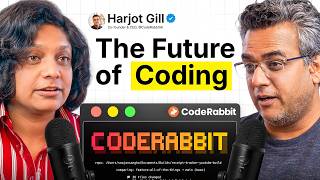
The Real Future of AI Coding in 2026 Isn't What You Think! CodeRabbit CEO Explains

The Real Future of AI Coding in 2026 Isn't What You Think! CodeRabbit CEO Explains

Why AI Code Review Goes First (And Humans Go Second) (feat: CodeRabbit)

Why AI Code Review Goes First (And Humans Go Second) (feat: CodeRabbit)

How CodeRabbit Got Thousands of Customers to Trust AI

How CodeRabbit Got Thousands of Customers to Trust AI

Cite This Interview

Use this interview in your research, article, or academic work

Related Interviews

Tom Siebel, Founder, Chairman & CEO at C3 AI
AI

Tom Siebel

Founder, Chairman & CEO at C3 AI

Approx. $20.8 Million
800+

In this interview, C3 AI founder, chairman, and CEO Tom Siebel discusses the historical evolution of enterprise artificial intelligence and the role of education in…

Read Interview
Dario Amodei, Co-founders (CEO & President) at Anthropic
AI

Dario Amodei

Co-founders (CEO & President) at Anthropic

Approx. $390 Million
3800+

In this interview, Anthropic co-founders Dario and Daniela Amodei address the safety and ethical dilemmas of rapid artificial intelligence development. The siblings discuss the capabilities…

Read Interview
Sam Altman, Co-founder & CEO at OpenAI
AI

Sam Altman

Co-founder & CEO at OpenAI

Approx. $2 Billion
8000+

In this interview, OpenAI co-founder and CEO Sam Altman discusses the shifting dynamics of startup creation, the trajectory of model scaling laws, and the geopolitical…

Read Interview
Monzy Merza, Co-founder & CEO at Crogl
AI

Monzy Merza

Co-founder & CEO at Crogl

Not Publicly Disclosed
6–20

In this interview, Crogl co-founder and CEO Monzy Merza discusses the evolution of security operations and the launch of the company's free enterprise-grade AI SOC…

Read Interview
Rajan Sethuraman, CEO at LatentView Analytics
AI

Rajan Sethuraman

CEO at LatentView Analytics

Approx. $10 Million
1190+

In this interview, LatentView Analytics CEO Rajan Sethuraman discusses the firm's non-exclusive services partnership with Anthropic to deploy Claude in enterprise environments. He details LatentView's…

Read Interview
Krishna Rangasayee, Founder & CEO at SiMa.ai
AI

Krishna Rangasayee

Founder & CEO at SiMa.ai

Not Publicly Disclosed
235+

In this interview, SiMa.ai founder and CEO Krishna Rangasayee discusses the transition of physical AI from early adoption to mainstream production. Speaking at the RAISE…

Read Interview