

Franklin WangFounder & CEO
In this interview, Liquid founder and CEO Franklin Wang discusses the integration of conversational AI with cryptocurrency perpetual futures trading. Wang details how the Co-Invest platform enables automated execution inside Claude and ChatGPT, explains safety architectures that isolate trading from withdrawal permissions, and shares insights on prediction markets and regulatory shifts. He also analyzes institutional competition between decentralized platforms and traditional exchanges.

Founder Stats
- Cryptocurrency
- Started 2025
- Not Publicly Disclosed/mo
- 6–20 team
- New York City, New York, United States
About Franklin Wang
Franklin Wang is the founder and CEO of Liquid, a multi-asset trading platform and perpetual futures aggregator. A Harvard graduate and former quantitative researcher at Two Sigma, Wang specializes in machine learning architectures and decentralized finance. Under his leadership, Liquid launched Co-Invest, enabling traders to analyze markets and execute automated trading routines directly through conversational AI interfaces.
Interview
September 01, 2026
This is interview 1 of 2 with Franklin Wang.
Franklin Wang has been featured on CEO Insider 2 times. Explore the full collection.
What is Liquid's core mission in the cryptocurrency trading landscape?
Liquid's goal is to build the best possible trading interface for everyone by focusing on perpetual futures. Perpetual futures allow continuous leverage and trade twenty-four hours a day, seven days a week. We are bringing these instruments to every accessible interface, including mobile applications, browser extensions, SMS, and conversational environments like Claude and ChatGPT.
How has user adoption for Co-Invest expanded recently?
Our user base has expanded rapidly. Two months ago, we had approximately fifteen hundred Co-Invest users, and we have now grown sevenfold to over ten thousand active users. Across our entire platform, our user base has grown from thirty-five thousand to well over sixty thousand traders with minimal direct marketing spend.
What makes perpetual futures the primary instrument for Liquid's trading interface?
Perpetual futures represent the most efficient instrument for active traders because they provide continuous leverage, run around the clock, and are increasingly moving toward formal regulatory acceptance. We aggregate liquidity from leading perpetual venues so users get the best execution across every asset class.
How do users leverage scheduled routines inside AI models to execute trades?
Traders can set up scheduled routines in Claude that run continuously, such as executing a custom market scan and placing trades every single hour. Once an investor defines their algorithmic criteria, the AI agent carries out the process autonomously without requiring manual human oversight for every market movement.
How does Liquid secure user funds when connecting trading accounts to AI interfaces?
Why would a trader choose Co-Invest over centralized exchange AI tools?
Centralized exchanges are fully custodial, meaning you become an unsecured creditor if the platform experiences insolvency. Furthermore, major centralized exchanges charge fees that can be up to ten times higher than decentralized aggregators while offering significantly lower liquidity on large volume orders.
Why has Liquid chosen not to support automated memecoin trading?
While enabling automated memecoin trading would be technically trivial to implement, we view memecoins as speculative attention games that do not contribute to real capital formation. Co-Invest is designed to help traders make disciplined, intelligent financial decisions, so we intentionally restrict automated memecoin purchases.
How does AI analyze macroeconomic legislation like the Clarity Act?
AI models evaluate policy events by synthesizing prediction market probabilities, Congressional hearings, sentiment metrics, and news coverage. For example, prediction data currently prices in a low probability of passage, which suggests market upside is not yet priced in if regulatory clarity is achieved.
How will regulatory integration of decentralized perpetuals impact traditional exchanges?
What role do pre-IPO perpetual markets play in price discovery for major tech companies?
Pre-IPO perpetual markets provide critical price discovery before official public listings occur. Historical data from pre-IPO contracts shows that decentralized markets have predicted initial public trading prints within one percent accuracy, giving institutional participants transparent benchmarks.
How quickly are traditional finance investors adopting decentralized trading platforms?
Traditional investors are moving into decentralized platforms very rapidly. When traditional market participants learn that they can gain pre-IPO synthetic exposure to high-growth AI companies and execute twenty-four-hour trades with lower friction, they readily migrate capital into aggregator platforms.
Why is exchange aggregation essential for the perpetual futures ecosystem?
What is your outlook on the ongoing AI chip and compute narrative?
The compute rally has been driven by massive real demand for memory and processing power from frontier AI labs. While the sector has experienced sharp valuation increases, major AI developers continue to sign multi-billion-dollar power and data center commitments, ensuring sustained demand for hardware infrastructure.
Why are cloud-hosted AI agents superior to locally run agents for financial automation?
What is Liquid's strategy regarding multi-chain integration and new networks?
Table Of Questions
Video Interviews with Franklin Wang
How To Maximize Gains With A.I. Trading Perps 💰 Liquid CEO INTERVIEW
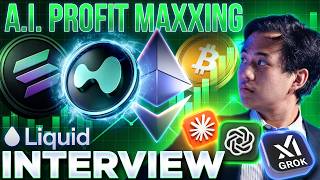
How To Maximize Gains With A.I. Trading Perps 💰 Liquid CEO INTERVIEW

Liquid: The Future of AI Trading & Perpetual Futures
Cite This Interview
Use this interview in your research, article, or academic work
Related Interviews
Franklin Wang
Founder & CEO at Liquid
In this interview, Liquid founder and CEO Franklin Wang discusses the integration of conversational AI with cryptocurrency perpetual futures trading. Wang details how the Co-Invest…

Se Yong Park
Co-Founder at Fomo
In this interview, Fomo co-founder Se Yong Park discusses the rise of their social cryptocurrency trading platform and their focus on retail onboarding. Park explains…

Mert Mumtaz
Co-Founder & CEO at Helius
In this interview, Helius CEO Mert Mumtaz discusses the company's developer tooling infrastructure on the Solana network and their recent acquisition of Light Protocol. Mumtaz…

Michael Saylor
Founder & Chairman at MicroStrategy
In this interview, MicroStrategy co-founder and Chairman Michael Saylor discusses the utility of Bitcoin as a digital capital store of value. Saylor explains why fiat…

Bill Barhydt
Founder & CEO at Abra
In this interview, Abra founder and CEO Bill Barhydt shares a macro perspective on the cryptocurrency market cycle, contrasting price volatility with exponential technology growth.…
Brian Armstrong
Co-founder & CEO at Coinbase
In this interview, Coinbase co-founder and CEO Brian Armstrong joins Nikhil Kamath to explore the evolution of global finance, stablecoin economics, and cryptocurrency opportunities in…