
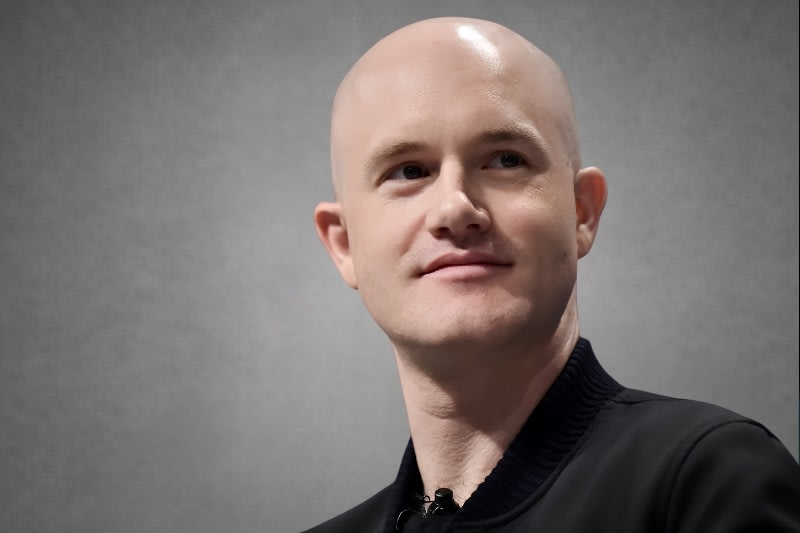
Brian Armstrong, Co-founder & CEO at Coinbase
4.1/5 Rating
Cryptocurrency
Approx. $ 598.3 Million /mo
$ 7.18 Billion ARR

Brian ArmstrongCo-founder & CEO

In this interview, Coinbase co-founder and CEO Brian Armstrong joins Nikhil Kamath to explore the evolution of global finance, stablecoin economics, and cryptocurrency opportunities in India. Armstrong explains how agentic commerce enables AI agents to transact globally, details the pass-through yields of USDC under the Clarity Act, and outlines Coinbase's registered FIU relaunch in India. He analyzes the advantages of 100% reserve banking over fractional reserves and the role of digital assets in reducing transaction friction.

Brian Armstrong

Brian Armstrong

Co-founder & CEO

Coinbase

Coinbase

Founder Stats

  • Cryptocurrency
  • Started 2012
  • Approx. $ 598.3 Million /mo
  • 4200+ team
  • Remote-First (San Francisco, California, United States)

About Brian Armstrong

Brian Armstrong is the co-founder and CEO of Coinbase, the leading cryptocurrency exchange in the United States. Since co-founding Coinbase in 2012, he has scaled the firm into a publicly traded platform with billions in annual revenue, driving the global adoption of digital assets. Under his leadership, Coinbase has expanded into institutional custody, developer infrastructure, and stablecoin projects like USDC, while advocating for clear crypto regulatory frameworks worldwide.

Interview

July 17, 2026

Q

How do you define the role of philanthropy in a capitalist society?

Question 1 of 18
Brian Armstrong

Philanthropy is like starting a business; many initiatives fail, but the best ones accomplish incredible things. Ultimately, wealth can only go to taxes, philanthropy, or children, making it a critical tool for social improvement when executed effectively.

0
Q

What is the best way to address growing wealth and income inequality?

Question 2 of 18
Brian Armstrong

The most effective solution is to turn everyone into a capitalist by democratizing access to equity ownership. Giving children starting assets at birth or utilizing employee equity alignment tools ensures that lower-income populations participate in asset growth.

0
Q

What is the relative change in wealth, and how does it impact human happiness?

Question 3 of 18
Brian Armstrong

Human happiness is deeply tied to relative comparisons. Even if a rising tide lifts all boats and everyone's baseline quality of life improves, flat purchasing power coupled with others becoming exponentially wealthier creates significant social unrest and envy.

0
Q

Is it possible for the global community to collectively pause AI development?

Question 4 of 18
Brian Armstrong

It is highly unrealistic. Even if the United States agreed to a pause, competitors like China would not. Furthermore, verifying compliance is impossible because data centers can easily turn off training runs during inspections and restart them immediately after.

0
Q

How should countries like India position themselves in the global AI value chain?

Question 5 of 18
Brian Armstrong

India should focus on building top-tier AI companies and capturing value within specific segments, such as AI infrastructure and the energy value chain. Leveraging India's massive engineering talent pool will allow it to capture significant value.

0
Q

What is agentic commerce, and how does it change the financial ecosystem?

Question 6 of 18
Brian Armstrong

Agentic commerce refers to autonomous AI agents performing work and making transactions on behalf of users. Since these agents need to pay for API calls, data, and research papers, they require a new friction-free financial layer.

0
Q

Why are blockchain networks and stablecoins suited for autonomous AI payments?

Question 7 of 18
Brian Armstrong

AI agents cannot open traditional bank accounts or obtain government IDs. However, they can instantly spin up self-custodial crypto wallets. Stablecoins also enable instant, global micro-transactions of less than a cent, which credit card networks cannot handle.

0
Q

Why are know-your-customer regulations a significant point of friction for AI agents?

Question 8 of 18
Brian Armstrong

Know-your-customer and anti-money laundering regulations introduce high compliance costs and transaction friction. Research shows that only about 1% of global illicit activity is successfully frozen, raising questions about the cost-benefit trade-offs of these frameworks.

0
Q

How are stablecoin transactions funded, and what is the underlying business model?

Question 9 of 18
Brian Armstrong

Stablecoin issuers hold the underlying fiat reserves in government bonds, earning interest that funds their business. A tiny transaction fee is also paid to the blockchain network to cover the operational cost of sequencers and nodes.

0
Q

How does the Clarity Act regulate pass-through treasury rewards for stablecoin holders?

Question 10 of 18
Brian Armstrong

To address banking concerns, the latest draft of the Clarity Act prohibits paying rewards on completely idle balances. However, as long as a customer is actively transacting or trading, they remain eligible to receive the majority of the underlying treasury yield.

0
Q

How can stablecoin users earn yield on top of standard treasury returns?

Question 11 of 18
Brian Armstrong

Users can choose to opt in and lend their stablecoins directly into decentralized finance protocols. This allows them to earn additional yield on their assets on top of standard interest returns.

0
Q

Why would a user hold stablecoins rather than purchasing short-term treasuries directly?

Question 12 of 18
Brian Armstrong

Stablecoins merge yield generation with transaction utility. In traditional finance, money market funds pay yield but cannot be spent directly, while checking accounts allow spending but yield nothing. Stablecoins combine these functions into a single pool.

0
Q

Why do traditional banks separate checking and savings accounts?

Question 13 of 18
Brian Armstrong

Banks intentionally create this separation to capture a larger net interest margin spread. They want to hold deposits in checking accounts where they pay zero interest, allowing them to monetize those deposits for their own benefit.

0
Q

How does the cost structure of a modern fintech compare to a traditional bank?

Question 14 of 18
Brian Armstrong

Fintech firms are much more efficient. By operating without physical branches or skyscraper headquarters, and by utilizing AI and automation to streamline compliance, they can pass significantly more economic benefits back to the consumer.

0
Q

Why has the integration of stablecoins into remittance corridors like India been slow?

Question 15 of 18
Brian Armstrong

India lacks stablecoin off-ramps. The Indian government has historically been disincentivized to support dollar-backed stablecoin ecosystems because they want to protect their tight fiscal policy and maintain monetary sovereignty over the rupee.

0
Q

What are the details of Coinbase's relaunch and regulatory compliance in India?

Question 16 of 18
Brian Armstrong

Coinbase has established a local entity and registered with the Financial Intelligence Unit. We have secured access to local payment rails like UPI, making Coinbase the first international crypto player in India with a local license.

0
Q

Can physical gold reserves be tokenized to unlock global liquidity?

Question 17 of 18
Brian Armstrong

Yes, any asset can be tokenized, including gold, stocks, and bonds. Tokenization provides a liquid, globally distributable market with real-time settlement, eliminating the need to physically transport or divide the underlying commodity.

0
Q

How does Bitcoin function as digital gold compared to peer-to-peer cash?

Question 18 of 18
Brian Armstrong

Bitcoin succeeded as a store of value rather than a medium of exchange. Because it is a deflationary and volatile asset, people prefer to hold it as digital gold, while stablecoins have emerged as the primary transactional currency.

0

Video Interviews with Brian Armstrong

Coinbase CEO: Why Banks Shouldn't Hold Your Money | Brian Armstrong x Nikhil Kamath | People by WTF

Coinbase CEO: Why Banks Shouldn't Hold Your Money | Brian Armstrong x Nikhil Kamath | People by WTF

Coinbase CEO: Why Banks Shouldn't Hold Your Money | Brian Armstrong x Nikhil Kamath | People by WTF

Jamie Dimon called him 'full of s--t.' Brian Armstrong answers.

Jamie Dimon called him 'full of s--t.' Brian Armstrong answers.

Brian Armstrong - CEO of Coinbase | Podcast | In Good Company | Norges Bank Investment Management

Brian Armstrong - CEO of Coinbase | Podcast | In Good Company | Norges Bank Investment Management

Cite This Interview

Use this interview in your research, article, or academic work

Related Interviews

Palmer Luckey, Founder at Anduril Industries
Technology

Palmer Luckey

Founder at Anduril Industries

Approx. $ 183.3 Million
7000+

In this interview, Anduril Industries founder Palmer Luckey discusses the company's culture and its rapid deployment of autonomous defense products like the Fury fighter jet.…

Read Interview
Cathie Wood, Founder, CEO & CIO at ARK Invest
Finance

Cathie Wood

Founder, CEO & CIO at ARK Invest

Not Publicly Disclosed
100+

In this interview, ARK Invest founder and CEO Cathie Wood discusses Bitcoin bottoming and emerging into a broad multi-year uptrend. Wood details critical macroeconomic metrics,…

Read Interview
Collin Kettell, Founder & CEO at Palisades Goldcorp
Finance

Collin Kettell

Founder & CEO at Palisades Goldcorp

Not Publicly Disclosed
100+

In this interview, Palisades Goldcorp founder and CEO Collin Kettell discusses their unique warrant-centric resource investment strategy at the Rick Rule Symposium. He details the…

Read Interview
Rajan Sethuraman, CEO at LatentView Analytics
AI

Rajan Sethuraman

CEO at LatentView Analytics

Approx. $10 Million
1190+

In this interview, LatentView Analytics CEO Rajan Sethuraman discusses the firm's non-exclusive services partnership with Anthropic to deploy Claude in enterprise environments. He details LatentView's…

Read Interview
Krishna Rangasayee, Founder & CEO at SiMa.ai
AI

Krishna Rangasayee

Founder & CEO at SiMa.ai

Not Publicly Disclosed
235+

In this interview, SiMa.ai founder and CEO Krishna Rangasayee discusses the transition of physical AI from early adoption to mainstream production. Speaking at the RAISE…

Read Interview
Prudhvi Raj Pakalapati, Co-Founder & CEO at Vector Technics
Technology

Prudhvi Raj Pakalapati

Co-Founder & CEO at Vector Technics

Approx. $0.48 Million
22+

In this interview, Vector Technics co-founder and CEO Prudhvi Raj Pakalapati discusses the company's expansion to a manufacturing capacity of 300,000 drone propulsion units annually.…

Read Interview