
Krishna Rangasayee, Founder & CEO at SiMa.ai
4.7/5 Rating
AI
Not Publicly Disclosed/mo
Not Publicly Disclosed ARR

Krishna RangasayeeFounder & CEO

In this interview, SiMa.ai founder and CEO Krishna Rangasayee discusses the transition of physical AI from early adoption to mainstream production. Speaking at the RAISE Summit in Paris, he explains the launch of their Gen 2 silicon and a pin-to-pin GPU system-on-module replacement. Rangasayee outlines their new agentic software wrapper, Palette Ne, which enables programming edge applications in plain English, and highlights strategic partnerships in automotive, robotics, and drone technology.

Krishna Rangasayee

Krishna Rangasayee

Founder & CEO

SiMa.ai

SiMa.ai

Founder Stats

  • AI
  • Started 2018
  • Not Publicly Disclosed/mo
  • 235+ team
  • San Jose, California, United States

About Krishna Rangasayee

Krishna Rangasayee is the founder and CEO of SiMa.ai, an Edge AI hardware and software company valued as a leading deep-tech innovator. Before founding the company in 2018, he spent nearly two decades in senior executive roles at Xilinx and Groq. Under his leadership, SiMa.ai has raised 355 million USD to deliver purpose-built Machine Learning System-on-Chip (MLSoC) solutions, helping enterprises seamlessly deploy power-efficient physical AI applications.

Interview

July 14, 2026

This is interview 2 of 2 with Krishna Rangasayee.

Krishna Rangasayee has been featured on CEO Insider 2 times. Explore the full collection.

Q

How do you view the current massive investment cycle in AI infrastructure?

Question 1 of 13
Krishna Rangasayee

We are in an amazing set of circumstances. While it looks like an enormous investment cycle today, we will look back in twenty or thirty years and realize this was just the very beginning of the AI journey.

0
Q

What does the transition of AI from the cloud to the physical world mean for society?

Question 2 of 13
Krishna Rangasayee

We have seen massive AI adoption in the cloud, but the next step is moving compute closer to where we live. As AI touches and integrates with the physical world, it will expand its footprint and completely reshape our daily lifestyles.

0
Q

What is SiMa.ai's current positioning and what are your primary target markets?

Question 3 of 13
Krishna Rangasayee

Physical AI is entering mainstream focus and adoption. Our top three volume markets are robotics, automotive, and drones, though we are also seeing significant participation in medical, aerospace, and defense applications.

0
Q

How does your Gen 2 platform simplify hardware migration for customers?

Question 4 of 13
Krishna Rangasayee

Our Gen 2 platform and silicon are now in production. We designed it to allow a friction-free transition from GPU AI infrastructure to our far more power-efficient and capable MLSoC platforms.

0
Q

What is a System on Module (SOM) form factor and how does it accelerate time to production?

Question 5 of 13
Krishna Rangasayee

A SOM is a system-on-module board that helps customers speed up product development. We have launched a pin-to-pin replacement for the industry's leading GPU SOM, meaning developers can physically swap out a GPU for our module in seconds.

0
Q

Can you share the strategic importance of your partnership with Micron?

Question 6 of 13
Krishna Rangasayee

While we cannot disclose the full details of our partnership, memory is incredibly critical to scaling AI. Micron is an outstanding partner, and together we are focused on bringing combined value in compute and memory to our customers.

0
Q

Why is heterogeneous compute critical for scaling AI inference and reasoning?

Question 7 of 13
Krishna Rangasayee

There is no one-size-fits-all solution for AI. As AI moves into reasoning and inference workloads, developers need heterogeneous compute rather than a GPU-only structure. Our platform integrates Arm processors, Synopsys DSPs, and our own proprietary machine learning accelerator.

0
Q

How is the drone market evolving with the integration of AI?

Question 8 of 13
Krishna Rangasayee

Drones are transitioning from traditional first-person view units to fully AI-enabled, GPS-denied systems that can navigate without knowing the environment beforehand. Due to current geopolitics, we expect massive demand for AI drones and anti-drone technology.

0
Q

How do you view the timeline for the commercial adoption of humanoid robots?

Question 9 of 13
Krishna Rangasayee

While we participate in the humanoid space, my view is that the adoption of humanoids will happen at a much slower pace than the market currently expects. However, the AI-enablement of traditional mobile, warehouse, and logistics robots is scaling rapidly today.

0
Q

How are traditional outdoor robotics, like lawnmowers, becoming agentic?

Question 10 of 13
Krishna Rangasayee

We are seeing traditional tools like lawnmowers become autonomous and agentic. With our technology, users can speak directly to a mower to set schedules, and the machine itself can predict when its rotors need replacement, removing the need for manual monitoring.

0
Q

What is the difference in market risk between edge AI and enterprise software applications?

Question 11 of 13
Krishna Rangasayee

Unlike enterprise software applications where companies are searching for revenue and product-market fit, edge AI targets existing, known markets. We are introducing new productivity and capabilities to established industries, so there is no market risk.

0
Q

How does your new agentic software wrapper, Palette Ne, simplify AI programming?

Question 12 of 13
Krishna Rangasayee

Palette Ne acts as an agentic wrapper on our software development kit. It allows developers to build complex edge systems in plain English rather than complex code, reducing the time to migrate and bring applications to production from months to hours.

0
Q

Why are traditional GPUs an inefficient fit for physical AI at the edge?

Question 13 of 13
Krishna Rangasayee

GPUs are graphics cards built primarily for data centers. They are far too power-hungry and inefficient for edge applications. Physical AI requires ruggedized, cost-effective, and power-efficient silicon designed specifically for industrial edge environments.

0

Video Interviews with Krishna Rangasayee

Krishna Rangasayee, SiMa AI | RAISE Summit 2026
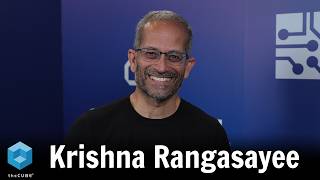
 Krishna Rangasayee, SiMa AI | RAISE Summit 2026
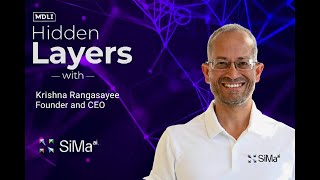
Krishna Rangasayee, SiMa AI | RAISE Summit 2026

AI on the Edge - Interview with Krishna Rangasayee, Founder and CEO of SiMa.ai
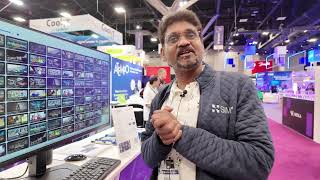
AI on the Edge - Interview with Krishna Rangasayee, Founder and CEO of SiMa.ai

SiMa.ai MLSoC + Advantech at #sc25 80x 1080p30 video analytics, edge LLM under 10W

SiMa.ai MLSoC + Advantech at #sc25 80x 1080p30 video analytics, edge LLM under 10W

Cite This Interview

Use this interview in your research, article, or academic work

Related Interviews

Rajan Sethuraman, CEO at LatentView Analytics
AI

Rajan Sethuraman

CEO at LatentView Analytics

Approx. $10 Million
1190+

In this interview, LatentView Analytics CEO Rajan Sethuraman discusses the firm's non-exclusive services partnership with Anthropic to deploy Claude in enterprise environments. He details LatentView's…

Read Interview
Jeff Cardenas, Co-Founder & CEO at Apptronik
AI

Jeff Cardenas

Co-Founder & CEO at Apptronik

Not Publicly Disclosed
300+

In this interview, Apptronik co-founder and CEO Jeff Cardenas outlines the rapid expansion of physical AI and humanoid robotics. Speaking at the Race Summit in…

Read Interview
Aravind Srinivas, Co-Founder & CEO at Perplexity AI
AI

Aravind Srinivas

Co-Founder & CEO at Perplexity AI

Approx. 41.6 Million
1400+

In this interview, Perplexity AI co-founder and CEO Aravind Srinivas challenges the conventional 9-to-5 desk job, identifying it as a corporate strategy engineered by Microsoft…

Read Interview
Jamie Stewart, Founder & CEO at Binq
AI

Jamie Stewart

Founder & CEO at Binq

Not Publicly Disclosed
6–20

In this interview, Jamie Stewart shares how he transitioned from an international music career into fintech entrepreneurship by founding Binq, an AI-powered business assistant for…

Read Interview
Nicholas Harris, Co-founder & CEO at Lightmatter
AI

Nicholas Harris

Co-founder & CEO at Lightmatter

Not Publicly Disclosed
200+

In this interview, Lightmatter co-founder and CEO Nicholas Harris explains how the company evolved from photonic computing to silicon photonics for AI networking. He discusses…

Read Interview
Mitesh Agrawal, Chief Executive Officer at Positron AI
AI

Mitesh Agrawal

Chief Executive Officer at Positron AI

Not Publicly Disclosed
70+

In this interview, Mitesh Agrawal explains how Positron AI is building purpose-built inference hardware to address AI's growing memory bottlenecks while competing alongside NVIDIA rather…

Read Interview