
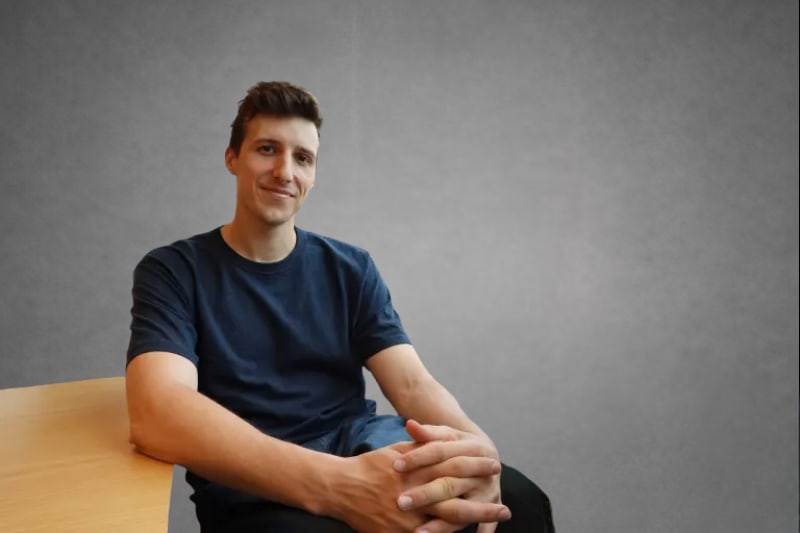
Walter GoodwinFounder & CEOCustom in-memory silicon architecture and the global AI inference compute crisis
In this interview, Walter Goodwin, Founder and Chief Executive Officer of Fractile, analyzes the exponential hardware bottlenecks threatening the generative artificial intelligence industry and outlines his company custom silicon architecture. Drawing from his computational neuroscience background, he explains why memory bandwidth limits legacy processors, how in-memory computing accelerates model latency by orders of magnitude, and the dynamics of raising a 720 Million USD Series C. Goodwin shares strategic principles on competing against entrenched semiconductor titans.


Founder Stats
- Technology
- Started 2022
- $2.5M/mo
- 50–200 employees
- London, England, UK
About Walter Goodwin
Walter Goodwin is the Founder and Chief Executive Officer of Fractile, a British semiconductor enterprise engineering next-generation processors specifically optimized for artificial intelligence model inference. Holding advanced degrees in computational neuroscience and computer science from University College London, he pioneered novel in-memory computing architectures that eliminate traditional memory bandwidth bottlenecks. Goodwin has raised over 940 Million USD in institutional capital from premier global technology investors, positioning Fractile at the forefront of semiconductor innovation.
Interview
November 16, 2026
Why is the global artificial intelligence industry currently facing an unprecedented inference compute crisis?
Everyone recognized the training compute crunch early on, but running models in live production requires thousands of times more aggregate operations. When millions of autonomous agents query models continuously every second, legacy graphics processors become prohibitively expensive and energy-intensive. Without radical silicon architectural breakthroughs, the operational expense of model inference will halt widespread commercial adoption.
How does the traditional memory bandwidth bottleneck restrict current generation graphics processing units?
In standard computing architectures, processor cores sit physically separated from memory banks. During generative model inference, moving trillions of parameters across high-bandwidth memory buses consumes ninety percent of total execution time and electrical energy. The compute units spend most of their cycles idle, waiting for data to travel across the silicon substrate.
What architectural innovation allows Fractile in-memory compute chips to achieve dramatic speedups?
We perform mathematical calculations directly inside the memory arrays themselves, eliminating the need to shuffle data back and forth across physical interconnects. By integrating specialized low-power analog computing into dense memory structures, our chips deliver up to fifty times greater throughput per watt. We solve the data transfer dilemma at the fundamental physics level.
How did you secure a 720 Million USD Series C funding round valuing Fractile at 7.5 Billion USD?
Semiconductor design is a capital-intensive domain that leaves zero margin for incremental prototypes. We demonstrated working silicon test chips that validated our mathematical simulations to elite investors like Thrive and Founders Fund. When tier-one investors realized our architecture delivers generational efficiency gains for hyper-scale datacenters, they provided the massive capital reserves required to commercialize.
What commercial dynamics will unfold as foundation artificial intelligence models transition toward commoditization?
While base model weights are commoditizing rapidly, the demand for inference hardware is compounding exponentially. If intelligence becomes virtually free at the software layer, enterprise usage explodes by orders of magnitude. The entities controlling the most efficient physical computing infrastructure will capture massive value as model access expands across global industries.
How do you overcome the developer ecosystem lock-in established by legacy GPU software stacks?
Hardware is utterly useless without frictionless software compilation. We built an automated compiler pipeline that ingests standard PyTorch and ONNX model graphs directly, automatically mapping neural network weights onto our custom in-memory silicon. Developers can deploy frontier models on our hardware instantly without rewriting low-level kernel drivers or modifying existing training pipelines.
What unique operational challenges exist when managing physical semiconductor fabrication cycles?
Hardware demands absolute perfection before tape-out. You cannot push a software patch over the air if your physical photomask has an architectural defect. Every silicon iteration costs millions of dollars. Our engineering teams run exhaustive emulation testing for months before sending design files to the foundry.
Why did you choose to build a frontier semiconductor business in the United Kingdom?
The United Kingdom boasts an extraordinary heritage in computer architecture and analog chip engineering, from ARM to world-class university research labs in London and Cambridge. We tapped into an exceptional density of specialized silicon talent that Silicon Valley firms frequently overlook. Proximity to elite researchers allowed us to build our foundation team rapidly.
How do power grid constraints and electrical availability influence datacenter hardware procurement?
Modern datacenter operators can no longer secure endless megawatts of electrical grid capacity from utility companies. Facility expansion is bounded strictly by power ceilings. Datacenters will aggressively deploy processors that maximize inference tokens per megawatt. Power efficiency has surpassed raw clock speed as the defining benchmark for commercial procurement decisions.
What operational advice do you have for hardware founders navigating multi-year development cycles?
Hardware requires extreme psychological stamina because feedback loops stretch over years rather than days. You must maintain maniacal conviction in your theoretical physics while obsessively de-risking individual architectural modules step by step. Celebrate tiny simulation milestones internally to keep morale high, and never compromise on engineering hiring standards under schedule pressure.
How has your executive leadership role transformed as Fractile scaled to hundreds of millions in capital?
In the early days, I spent eighty percent of my time debugging transistor simulations alongside our lead engineers. Today, my primary responsibility is organizational architecture, capital allocation, and securing enterprise customer partnerships with major cloud providers. Leadership means setting the strategic tempo, removing friction, and ensuring brilliant specialists execute toward a shared technical vision.
What is the single most valuable lesson you have learned about launching deep technology ventures?
Never attempt an audacious technological venture unless you have an unfair insight into fundamental physical or mathematical limits. Chasing incremental improvements against incumbent monopolists is financial suicide. You must identify a structural architectural bottleneck that incumbents cannot easily fix without cannibalizing their core business, and execute with relentless speed.
Table Of Questions
Video Interviews with Walter Goodwin
The AI Compute Crisis: Why We Need Thousands of Times More Computing Power - Walter Goodwin (Interview Video)

The AI Compute Crisis: Why We Need Thousands of Times More Computing Power - Walter Goodwin (Interview Video)

Frontier Chips for Frontier AI Labs, with Walter Goodwin, Founder/CEO of Fractile

The Future of Chips in the AI Era - Walter Goodwin and Sir Robin Saxby
Cite This Interview
Use this interview in your research, article, or academic work
Related Interviews
Amjad Masad
Founder & CEO at Replit
Browser-based IDEs and autonomous AI software agents at scale
In this interview, Amjad Masad, Founder and CEO of Replit, joins Paul Graham to analyze the transformation of software development in the artificial intelligence agent…
Guillermo Rauch
Founder & CEO at Vercel
The agent-driven cloud and how autonomous software scales to trillion-dollar out
In this interview, Guillermo Rauch, Founder and CEO of Vercel, examines the paradigm shift underway as autonomous software agents revolutionize cloud infrastructure and web development.…

Bill Gates
Founder & Former CEO at Breakthrough Energy
In this interview, Bill Gates, Founder of Breakthrough Energy and Co-Founder of Microsoft, forecasts two decades of profound socioeconomic disruption driven by artificial intelligence advancements.…
Jim VandeHei
Co-Founder & CEO at Axios
In this interview, Jim VandeHei, Co-Founder and CEO of Axios and co-author of Smart Brevity, analyzes how generative artificial intelligence and pervasive digital noise are…

Satya Nadella
Chairman & CEO, Microsoft at Microsoft
Open versus closed models and enterprise AI
In this interview, Satya Nadella, Chairman and CEO of Microsoft, assesses the architectural divergence between open-weight and closed artificial intelligence models and explains why proprietary…

Jake Cooper
Founder & CEO at Railway
In this interview, Jake Cooper, Founder and CEO of Railway, details how the cloud platform scaled to nearly 100 million USD in annual recurring revenue…