
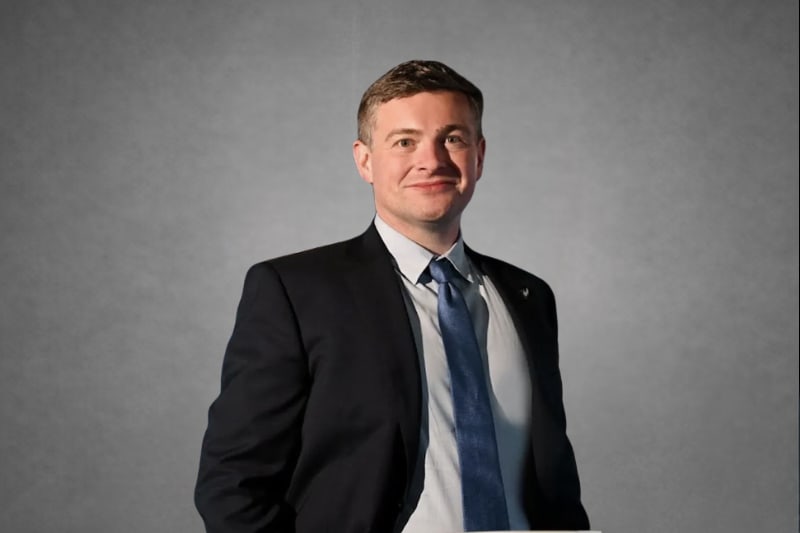
Blake SchollFounder & CEOTurning Crisis into Opportunity and Financing Supersonic Airliners
In this interview, Blake Scholl, Founder and CEO of Boom Supersonic, reveals how his company navigated near-fatal supplier abandonment to develop Symphony, a purpose-built supersonic jet engine. He explains how managing through extreme crisis requires doubling down on core innovation, why additive manufacturing disrupts legacy aerospace primes, and how commercial turbine applications provide sustainable pre-flight revenue.


Founder Stats
- Technology
- Started 2014
- Pre-revenue
- 50–200 employees
- Englewood, Colorado, USA
About Blake Scholl
Blake Scholl is the Founder and CEO of Boom Supersonic, the aerospace company developing Overture, the world fastest economically viable commercial airliner. A former Amazon executive and serial entrepreneur, Scholl founded Boom in 2014 to make supersonic commercial travel mainstream again. Under his leadership, Boom secured major aircraft order commitments from United Airlines, American Airlines, and Japan Airlines, while developing its proprietary Symphony propulsion engine.
Interview
November 24, 2026
How did you respond when Rolls-Royce unexpectedly pulled out of developing your supersonic engine in 2022?
When Rolls-Royce withdrew immediately after American Airlines announced major aircraft pre-orders, the media assumed our venture was dead. However, managing through a crisis does not mean compromising your standards to survive. Instead, you must do the exact opposite and lean into first principles. We realized that partnering with legacy primes would never produce an optimized supersonic propulsion system, so we decided to design our own engine.
Why did partnering with traditional legacy aerospace primes prove unworkable for supersonic innovation?
Traditional prime contractors have spent decades optimizing for quarterly financial metrics like return on net assets rather than technological innovation. Many experienced engineers at major primes were actually third-party contractors rather than permanent employees. By cutting through bureaucratic bloat, we were able to hire those world-class propulsion specialists directly, giving our engineering team complete design freedom without the stifling overhead of legacy aerospace corporate hierarchies.
How does Symphony differ technically from subsonic engines tweaked for supersonic flight?
Subsonic engines rely on large bypass turbofans that create enormous aerodynamic drag when approaching Mach speed. In contrast, Symphony is designed from the ground up for continuous high-temperature supersonic operation. It operates much more like an industrial power turbine than a conventional commercial airliner engine. This purpose-built design architecture enables boomless cruise and returns over one thousand miles of operational flight range to our commercial aircraft.
What role does additive manufacturing play in accelerating your propulsion development timelines?
Modern additive metal printing fundamentally alters the economics of aerospace prototyping. In the past, manufacturing complex turbine blades and combustion chambers required multimillion-dollar casting molds and eighteen-month supply chain lead times. With advanced additive machines, our engineers iterate complex fluid geometry overnight. This capability allows a lean startup to match the development velocity of organizations with fifty times our overall headcount.
How did you solve the daunting financial challenge of funding a deep-tech aerospace venture prior to commercial flights?
Developing a commercial airliner requires massive capital before carrying your first paying passenger. To bridge that gap, we developed a stationary power generation turbine variant using the identical core architecture as Symphony. The global energy market faces extreme turbine shortages, creating immediate high-margin commercial demand. Generating revenue from stationary power equipment enables us to self-fund flight testing without diluting company ownership through endless venture rounds.
What advantages does designing a clean-sheet supersonic cabin offer over legacy commercial aircraft?
Nobody has designed an all-new commercial passenger aircraft from a blank sheet since the widespread adoption of modern high-speed mobile internet. Legacy airliners bolt on heavy external radomes that ruin aerodynamic efficiency. We integrated conformal connectivity antennas, whisper-quiet active noise cancellation, and private seat ergonomics directly into the composite fuselage, creating a passenger experience that makes subsonic commercial travel feel completely obsolete.
How did landing firm pre-orders from United Airlines and American Airlines validate your market vision?
When United Airlines placed our first major fleet order, skeptical industry observers called it an anomaly. When American Airlines followed shortly after with twenty firm aircraft, it proved that the world leading carriers recognize supersonic passenger speed as the definitive commercial differentiator. Those commitments generated over twenty-five billion USD in our total pre-order book, demonstrating that passenger willingness to cut travel times in half is massive.
How does Boom overcome the historic regulatory noise challenges that doomed Concorde?
Concorde was prohibited from flying overland because it created thunderous sonic booms that rattled ground communities. Overture solves this limitation through automated boomless cruise technology. By flying slightly below Mach one over populated landmasses and accelerating to Mach one point seven exclusively over oceans, our airliner complies with all modern airport noise regulations while slashing transoceanic journey times by fifty percent.
What leadership philosophy enables your engineering team to execute complex hard-tech projects under extreme public scrutiny?
Hard-tech leadership requires unrelenting optimism coupled with rigorous intellectual honesty. When our engine partnership collapsed, I gathered the entire company and showed them that our engineering fundamentals were completely sound. High-performing aerospace teams do not fear immense technical challenges. They thrive when given audacious goals, total ownership of their work, and the autonomy to build world-altering hardware without bureaucratic interference.
Why is vertical integration essential when building breakthrough hardware in the modern era?
Relying on legacy aerospace supply chains introduces crippling delays because incumbent vendors prioritize defense cost-plus contracts over commercial speed. When you vertically integrate critical propulsion components and flight control software, you maintain direct control over your technical destiny. Controlling your manufacturing tolerances and testing velocity is the only reliable way to compress decade-long development cycles into actionable quarterly milestones.
How does modern aerodynamic simulation and artificial intelligence reshape the design of supersonic airframes?
In the Concorde era, aerodynamicists built hundreds of wooden wind tunnel models and calculated fluid dynamics by hand over several years. Today, we simulate twelve complete engine variants across dozens of atmospheric flight regimes overnight using cloud compute clusters. Modern computational fluid dynamics identified the optimal airflow geometry that restored thousands of miles of cruising range before bending our first piece of titanium.
What is your long-term vision for the future of global passenger transportation over the next two decades?
Our ultimate mission is to make supersonic commercial travel affordable for everyone who flies. Faster transportation strengthens human connections, expands economic opportunity, and brings global cultures closer together. We envision a future where anyone can board an airplane and travel anywhere on Earth in four hours for the price of today standard economy ticket. Speed is the natural evolution of human progress.
Table Of Questions
Video Interviews with Blake Scholl
How Boom's Biggest Crisis Became Its Biggest Opportunity - Y Combinator (Interview Video)

How Boom's Biggest Crisis Became Its Biggest Opportunity - Y Combinator (Interview Video)
Blake Scholl: Why Plane Speed Stalled, Supersonic Commercial Flight, & Revolutionizing the Engine - All-In Podcast
Ending America's 52-Year Ban on Supersonic Flight, with Boom CEO Blake Scholl - ImproveThePlanet
Traditional Aerospace Supply Chains Are Cooked - Blake Scholl - MTS
Cite This Interview
Use this interview in your research, article, or academic work
Related Interviews

Kush Bavaria
Co-Founder & CEO at Ornn
Building GPU Compute Futures and Navigating the AI Neo-Cloud Economy
In this interview, Kush Bavaria, Co-Founder and CEO of Ornn, unpacks the financial mechanics of modern artificial intelligence infrastructure, neo-cloud economics, and GPU compute derivatives.…
Ulrik Lehrskov-Schmidt
Founder & Managing Director at Willingness to Pay
Why per-seat pricing is dead and how AI agents are transforming SaaS monetizatio
In this interview, Ulrik Lehrskov-Schmidt, Founder and Managing Director of Willingness to Pay, breaks down the collapse of the per-seat software pricing model in the…

Walter Goodwin
Founder & CEO at Fractile
Custom in-memory silicon architecture and the global AI inference compute crisis
In this interview, Walter Goodwin, Founder and Chief Executive Officer of Fractile, analyzes the exponential hardware bottlenecks threatening the generative artificial intelligence industry and outlines…
Amjad Masad
Founder & CEO at Replit
Browser-based IDEs and autonomous AI software agents at scale
In this interview, Amjad Masad, Founder and CEO of Replit, joins Paul Graham to analyze the transformation of software development in the artificial intelligence agent…
Guillermo Rauch
Founder & CEO at Vercel
The agent-driven cloud and how autonomous software scales to trillion-dollar out
In this interview, Guillermo Rauch, Founder and CEO of Vercel, examines the paradigm shift underway as autonomous software agents revolutionize cloud infrastructure and web development.…

Bill Gates
Founder & Former CEO at Breakthrough Energy
In this interview, Bill Gates, Founder of Breakthrough Energy and Co-Founder of Microsoft, forecasts two decades of profound socioeconomic disruption driven by artificial intelligence advancements.…