

Sanjeev KumarCEO
In this interview, DTSS CEO Sanjeev Kumar discusses the leadership principles behind managing a massive integrated facility management operations workforce of fifty thousand employees. Kumar explains how his engineering background and early career as an entrepreneur shaped his approach to problem-solving, details the structured corporate training pathways he established to build employee trust and dignity, and shares his advice on transitioning from operations to strategic CEO leadership.

Founder Stats
- Agencies
- Started 1994
- Approx. 15 Million USD/mo
- 50000+ team
- Bangalore, Karnataka, India
About Sanjeev Kumar
Sanjeev Kumar is the CEO of Dusters Total Solutions Services (DTSS), India's leading integrated facility management company founded in 1994. Kumar studied engineering at College of Engineering, Pune. He began his career in construction and co-founded a construction firm before moving into property management at IL&FS. He joined DTSS as an operations leader, climbing the ranks to COO and eventually CEO. Kumar focuses on tech-enabled transformation, workforce skilling, and operations scale.
Interview
August 11, 2026
What were some of the key influences from your childhood in Pune?
I grew up in Pune in a simple, lower-middle-class family. My father was a civilian defense employee. We lived with limited means and in a military setup. I went to a Kendriya Vidyalaya school where I played hockey and spent a lot of time in the library, which taught me to take my own value-based decisions.
How did studying engineering at College of Engineering, Pune shape your early career goals?
College of Engineering, Pune is one of the oldest engineering institutions in Asia. Studying there was a 360-degree experience of academics, sports, and rowing. It built my passion for mathematics and engineering, and the common goal for most students back then was to either enter the civil services or defense.
What did your managing director at Devi Construction teach you about the value of character?
During my first job interview, the managing director did not speak to me for forty-five minutes. I sat and observed his meticulous details. When he finally spoke, the entire conversation revolved around character. He taught me that you can hire skilled people, but character is what defines the culture of an organization.
Why did you decide to leave a stable engineering job to start your own construction company?
How did your father's sudden health crisis impact your plan to enter the civil services?
How did you first connect with DTSS as an unhappy customer?
In 2009, I was working as a regional director for IL&FS and DTSS was our service provider. We were facing serious quality issues, so I set up a meeting with the co-founder, Shamsheer. After a frank discussion, he called me the next day for coffee. We talked for over two hours and he invited me to join his team to help scale the company.
What led to your transition from heading operations to taking the role of CEO at DTSS?
I climbed every step in the hierarchy over sixteen years, from regional head to national head of operations, COO, and eventually CEO. When I transitioned, I had to learn the difficult practice of letting go of the day-to-day operations I had run for years and focusing on strategy and corporate culture.
Why was it important for you to work with a professional coach when you became CEO?
When you step into a CEO role, you naturally want to keep doing the operational work you are comfortable with. I worked with a professional coach who had a manufacturing background. Over eight months, he helped me shift my mindset to collaborate across departments and learn to say no to minor operational details.
How did observing a janitor cleaning a glass wall lead to your focus on worker skilling?
I saw a janitor cleaning a large glass wall without the proper tools. He had to bend down constantly to pick up his cloth and spray. When I asked how I could help, he suggested a simple tool holster. I realized that equipping workers with the right tools and training prevents fatigue and elevates their work into a skilled career.
How does DTSS support social security and career progression for its frontline warriors?
We refer to our frontline workers as warriors. We ensure their social security and offer structured training programs like the smart supervisor and executive development programs. We have people who started as janitors with basic education and have elevated themselves to general managers running business units.
How do you address the pushback and skepticism from managers regarding training programs?
What are the top challenges you currently face as the CEO of a major facility management company?
The biggest challenge is retaining the younger generation of workers aged twenty-four to thirty, who are restless for rapid career growth. We also navigate rising labor costs, labor shortages, and increasing client demands for sustainable, green cleaning solutions that reduce their carbon footprint.
How does DTSS leverage mobile technology to handle worker grievances and improve transparency?
We have a custom mobile application that connects all our frontline warriors. The app displays their credentials, payouts, and allows them to raise grievances directly. The moment a grievance is raised, the system enforces a strict turnaround time that our management team is held accountable to solve.
Why do you make your personal mobile number accessible to all fifty thousand employees?
What does the acronym TOP represent in the DTSS corporate values?
What advice do you have for first-time managers dealing with team chaos and targets?
Which books and historical figures have had the greatest influence on your leadership style?
Table Of Questions
Video Interviews with Sanjeev Kumar
From Lower-Middle-Class Roots to CEO of 50,000 people | Sanjeev Kumar | The Leadership Podcast
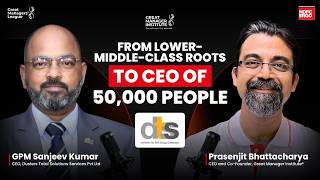
From Lower-Middle-Class Roots to CEO of 50,000 people | Sanjeev Kumar | The Leadership Podcast
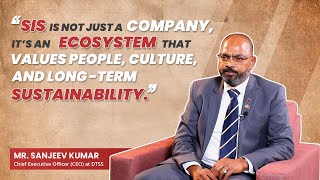
SIS Chronicles | Episode 23 | Mr. Sanjeev Kumar
Cite This Interview
Use this interview in your research, article, or academic work
Related Interviews

Edward Zitron
Founder & CEO at EZPR
In this interview, EZPR founder and CEO Ed Zitron critiques the generative artificial intelligence industry, characterizing the current boom as an unsustainable financial bubble. Zitron…

Tim Sweeney
Founder & CEO at Epic Games
In this interview, Epic Games founder and CEO Tim Sweeney discusses the future of Unreal Engine, the role of AI in game development, rising development…

RJ Scaringe
Founder & CEO at Rivian
In this interview, Rivian founder and CEO RJ Scaringe discusses building an electric vehicle company from the ground up, the future of transportation, AI-powered vehicles,…

Adam Goldstein
Founder & CEO at Archer Aviation
In this interview, Archer Aviation founder and CEO Adam Goldstein discusses the future of air taxis, the challenges of launching a new category of transportation,…

David Grutman
Founder & CEO at Groot Hospitality
In this interview, Groot Hospitality founder and CEO David Grutman shares how he built one of the most influential hospitality brands in the United States.…

Anton Oika
Co-Founder & CEO at Lovable
In this interview, Anton Osika, co-founder and CEO of Lovable, explains why the era of vibe coding is over and the era of serious AI-powered…