

Andrew FeldmanCo-founder & CEO
In this interview, Cerebras Systems co-founder and CEO Andrew Feldman details the engineering behind wafer-scale computing and the company's record-setting semiconductor IPO. Feldman explains why traditional GPUs struggle with fast AI inference, discusses memory and packaging bottlenecks, and explores the scaling requirements of agentic workflows. He shares lessons from the startup's early development struggles, analyzes the dilution of Nvidia's CUDA software moat, and outlines Cerebras's massive datacenter partnership with OpenAI.

Founder Stats
- Technology
- Started 2016
- Approx. $72 Million/mo
- 850+ team
- Sunnyvale, California, United States
About Andrew Feldman
Andrew Feldman is the co-founder and CEO of Cerebras Systems, the developer of the wafer-scale engine, the largest chip in computer history. Previously, Feldman co-founded and served as CEO of SeaMicro, a pioneer in energy-efficient microservers acquired by AMD in 2012. An experienced technology executive, he holds a bachelor's and master's degree from Stanford University and a Master of Business Administration from its Graduate School of Business, driving breakthroughs in high-performance hardware and AI cloud services.
Interview
July 29, 2026
Why has token speed become the dominant conversation in the AI sector?
What does speed mean in terms of user experience metrics?
How does the Netflix evolution analogy apply to the impact of fast inference?
How do you define the different choices made in the specialized chip landscape?
What did Nvidia's acquisition of Groq reveal about the GPU architecture's limits?
What is Broadcom's Jalapeno chip, and how does it fit into OpenAI's strategy?
What are the three major silicon manufacturing bottlenecks limiting GPU supply?
Why does Cerebras's wafer-scale engine process AI workloads faster than standard GPUs?
How does agentic AI drive an massive shortage of traditional CPUs?
Why is building model architecture directly into silicon design a structural mistake?
How did the team navigate the early years when the market was not ready?
Why do standard GPUs struggle with data movement during the decode phase of inference?
Why did Cerebras choose to build a dinner-plate-sized wafer-scale chip?
What was the hardest packaging problem you had to solve during early chip building?
How does Cerebras manage chip defects and yield reliability at the wafer scale?
Why do you argue that Nvidia's CUDA software platform is no longer a durable moat?
How does the 750-megawatt data center deal with OpenAI help scale their cloud footprint?
Why did TSMC agree to modify their manufacturing process for a 30-person startup in 2017?
Table Of Questions
Video Interviews with Andrew Feldman
Cerebras CEO: CUDA Is Not a Moat | Andrew Feldman
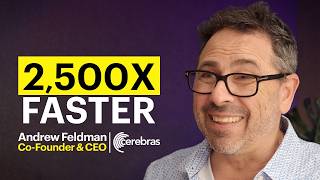
Cerebras CEO: CUDA Is Not a Moat | Andrew Feldman

Cerebras Systems IPO: Andrew Feldman on public debut
Cite This Interview
Use this interview in your research, article, or academic work
Related Interviews

Travis Kalanick
Founder & CEO at Atoms
In this interview, Atoms founder and CEO Travis Kalanick shares his vision for automating the physical world through industrial robotics and AI. Kalanick reflects on…
David Baszucki
Founder & CEO at Roblox
In this interview, Roblox co-founder and CEO David Baszucki discusses the platform's evolution into a major digital human co-experience platform. Baszucki outlines the value of…

Garry Tan
President & CEO at Y Combinator
In this interview, Y Combinator President and CEO Garry Tan outlines the new paradigms of software development driven by vibe coding and AI agents. Tan…

Ted Sarandos
Co-CEO at Netflix
In this interview, Netflix Co-CEO Ted Sarandos discusses the platform's ten-year journey in India and its global expansion strategy. Sarandos explains how Netflix matches content…
Brian Schimpf
Co-founder & CEO at Anduril Industries
In this interview, Anduril Industries co-founder and CEO Brian Schimpf discusses the shift in modern warfare toward AI-powered, software-first defense technologies. Schimpf shares the origin…

Amanda McMaster
Interim CEO at Boston Dynamics
In this interview, Boston Dynamics interim CEO Amanda McMaster explains the commercial transition of the pioneer robotics firm from research laboratory to industrial deployer. McMaster…