

Vineet NayarFormer CEO
In this interview, Vineet Nayar, former CEO of HCL Technologies, challenges conventional ideas about managing people, the role of Indian IT in the AI era, and what it means to raise a generation of seekers rather than copers. He explains why leadership is about inspiring clock speed rather than managing headcount, why AI still has no real use cases, why India Inc. must stop copying the West, and why the real transformation India needs starts not in the boardroom but at the dining table.

Founder Stats
- Technology
- Started 1976
- Not Publicly Disclosed/mo
- 218,000+ team
- Noida, Uttar Pradesh, India
About Vineet Nayar
Vineet Nayar is the former CEO of HCL Technologies, where he served from 2007 to 2013 and led the company from approximately 700 million USD in revenue to close to 5 billion USD in seven years. A graduate of G.B. Pant University and XLRI Jamshedpur, he joined HCL in 1985 and rose through the ranks before creating one of the most cited management frameworks in modern business, Employees First Customers Second. He is the founder and chairman of the Sampark Foundation, which works to transform learning outcomes for children in rural India, and an author and global keynote speaker on leadership and the future of work.
Interview
September 29, 2026
You managed close to 90,000 employees across more than 30 countries. What is the secret behind managing so many people and keeping them happy?
The word you are tripping on is manage. The word manage is a French word which literally means breaking a horse into submission. Ask yourself whether an employee wants to be managed. The answer is always no. In the industrial age we lined people up in rows and columns and managed them for productivity. As we move from productivity to innovation, people do not want management. They want to be inspired. The question for leaders now is how do you inspire people so that you do not have to manage. When you go to a mosque or a temple or a church and wash utensils and clean toilets, you feel good about it. When you come into the office and get paid, you feel bad. The reason is purpose. Without purpose, employees bring only 25 percent of themselves. If you can excite that employee and increase his clock speed from 25 percent to 50 or 70 percent, with the same product, same service, same customer, your results will be completely different.
If someone is graduating today and afraid of AI making them obsolete, how should they choose an industry and build a career?
Three things. First, take everything I say with a pinch of salt because nobody knows the answer. Second, lower your expectations. We are entering the mother of all storms. The number of opportunities will be lower than what the previous generation experienced and you need to set your mind to expect that. Third, focus on expanding your boundaries of logic and reason. Develop curiosity, experimentation, and the ability to apply knowledge. That is more important than which industry you enter. As for the industry, go into the industry itself, not consulting. The most exciting things are happening inside companies and wherever you land, your job is to become the transformer. It matters less where you start and more what you do when you get there.
How did you personally go from being an ant to becoming a butterfly? What was your journey?
I was 23 years old selling computers in Mumbai with a team of six or seven people and we had almost no market share. I went to a bookshop to buy a love letter card for my girlfriend, who became my wife. Next to the love cards I saw condolence cards. I picked up ten of them, brought them to the office, and told my team we should sign one and send it to the CEO of our biggest competitor every time we won a deal. Everyone laughed because we were not winning anything. But every day people would walk past the condolence cards on the desk and their desire to beat the competition grew. Over 18 months we went from less than one percent market share to 50 percent. Same product. Same service. Same employees. The trick was not the card. The trick was that when a human decides to want something, they find a way. Inspiring the desire for change is the real lever.
You are known for the philosophy of Employees First Customers Second. What does it actually mean in practice?
When HCL adopted employees first, we went from about 700 million USD in revenue to roughly 5 billion USD in seven years. Everything stayed the same. Same product, same service, same customers. What changed was the clock speed of the employees. The core logic is simple. The purpose of a company is to create differentiated value for customers. Who creates that differentiated value? Employees. So the role of a leader and a manager should be to enthuse, encourage, and enable employees, not to give instructions and measure compliance. If that is the role of management, then the employees are the natural people to evaluate whether their managers are actually playing that role. So we had one lakh employees do a confidential appraisal of me as CEO, which was made public every year. Behavior changed overnight.
You had employees publicly appraise you as CEO. Was that not an extremely dangerous thing to do?
Only if you are not confident as a leader. The question I asked myself was what is the role of a leader and why does a leader exist. The role of a leader is to get the best out of the people who work with them. That is it. If you can get the best out of me, you are a leader. If you only measure me and give instructions, you are a manager. If that is the definition, then only the people being led can tell you whether you are doing your job. Even a political leader goes to the people for votes every five years. Why should a corporate leader be immune from the same accountability? Two things happened when we launched this. Employees felt genuinely motivated because they had real power and voice. And managers became very clear about their actual role. The culture shifted from you better do it to can I help you do it.
Why do you believe that AI has no real use cases yet despite all the excitement around it?
We should understand when somebody is trying to sell us a lemon. Every technology company trying to sell you a subscription right now is selling you a lemon and the lemon is a promise that this technology is a solution for everything. It is not. When electricity came in it took 15 years before factories meaningfully automated using it. When the internet came in around 1993, it took seven years before genuinely new use cases like Amazon, Facebook, or remote infrastructure management emerged. Before that, the internet was just search and email. AI is in what I call the ugly duckling stage. It is a fantastic technology but nobody has figured out how to use it to create trillion dollar value based on real cash flows, not on hope. Go to any corporate leader and ask how much new revenue AI has generated that did not exist before. Nobody has an answer.
What is the difference between a coper and a seeker, and why do you think India is producing copers?
Copers copy the business models of the West. They reproduce what has already been invented. Seekers disrupt. Indian IT was disruptive. Indian pharma was disruptive to an extent. Kotak Mahindra Bank was disruptive. But right now, if you look at most Indian startups, they are copies of Western ideas applied to an Indian context. The question I ask is where is the disruptive thought going to come from and why is it not coming in volume. The answer starts at the dining table. My generation has the disease of prescription. We tell our children what not to do. Do not take that taxi. Do not talk to that person. Do not try that idea. We are a don't generation. We are fearful because we have accumulated some wealth and we are terrified of losing it. You cannot produce curiosity and experimentation in a child you are busy protecting. Disruptive thinkers are raised, not taught.
What must Indian IT companies do to remain relevant as AI disrupts their core business model?
The genesis of Indian IT was offshore software development combined with CMM level five quality certification at lower cost. That was the disruption. It worked because it solved a real and specific problem. Today the customer is not looking for cost reduction. The customer is facing obsolescence of their processes, products, and business models because of AI. They are worried they are going to die if they do not transform. The question is can Indian IT companies speak to that worry and demonstrate that they can help solve it, or do they continue selling cost reduction. The companies that pivot to transformation will grow. The ones that stay comfortable on their cash flows and grow at three to five percent will slowly become irrelevant. The biggest enemy of Indian IT right now is its own accumulated success.
HCL chose not to lay off a single employee during the 2008 recession under your leadership. Why?
The logic was counterintuitive. If you lay off people during a downturn, the people who remain know their number is coming next. Demotivation sets in immediately. The cost of that demotivation is enormous and invisible. Our bet was to say no one's livelihood is being taken away. It cost us somewhere between 100 and 200 million USD. But the employees who stayed were motivated. They went to customers in a motivated fashion and they stole market share from competitors who were laying off and demoralizing their own people. HCL never went into degrowth during the recession. We were one of the very rare companies that maintained positive growth all the way through. The problem of protecting our people became our competitive solution. Counterintuitive risk-taking in a storm is often the best strategy.
What is your message to parents about how to raise the next generation of disruptive thinkers?
I am speaking directly to parents when I say this. Your children are getting obsolete because of AI. Any knowledge you transfer to them through the current education system, AI will do better. That is true and it is correct to be concerned. But the answer is not to outsource this to schools, which will take decades to change. The answer is curiosity and experimentation, and that has to start at the dining table. Stop prescribing. Stop warning. Stop protecting. Start asking questions. Ask your child why. Ask what if. Ask them to research something and bring it back to you. If you can keep your mouth shut a little longer and let curiosity take over the conversation, you will produce a seeker. That journey from followers to seekers, experimenters, researchers, and disruptors starts at home. Nobody else is going to do it.
What is your view on the growing gap between CEO compensation and entry-level salaries in Indian IT?
There are two separate conversations. On entry-level salaries, the starting salary is low partly because Indian graduates are not immediately deployable. The organization has to invest six to twelve months in skilling them before they become productive. So the starting salary is effectively an investment salary. But if you choose the right vertical, a rare and high-growth technology area rather than testing or legacy coding, the salary acceleration can be significant. A crore rupee salary within ten years is not unusual in the right track. On CEO compensation, my question is not whether the number is high. My question is whether the compensation is linked to transformation actually delivered. If a CEO moves a company from X dollars in valuation to 100X, the compensation is fair. If transformation never happens and employees and shareholders do not gain, then the compensation is not justified. The logic is the same as a startup founder who makes money only if the company succeeds.
What is your vision for how India can turn this AI moment into a generational leap forward?
This is the mother of all moments to take risk because the churn is universal. Nobody has the answers yet. Nobody knows the real use cases. Everybody is equally in the dark. This is the best possible time for India to run ahead because the playing field is level. The choice is between putting your head down and preserving cash or betting on this window to grab market share and define new categories. Every sector, pharma, manufacturing, IT, everything has an opportunity right now to step into the disruption and lead rather than follow. What India needs is not risk capital in 500,000 USD startup bets. India needs billions of dollars flowing into big, bold, non-obvious ideas. That is the only way a country with our population can create enough growth to serve everyone. If we get that right, the trajectory changes. If we do not, we will keep copying.
Table Of Questions
Video Interviews with Vineet Nayar
Ex-HCL CEO's Career Survival Masterclass: How To Stay Valuable When Opportunities Shrink | FWS

Ex-HCL CEO's Career Survival Masterclass: How To Stay Valuable When Opportunities Shrink | FWS

Vineet Nayar on AI, Human Leadership & the Future of Work (DeKoder)
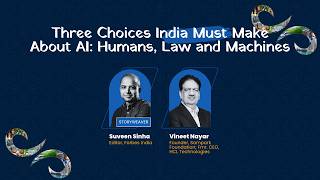
Why Does Monday Feel So Exhausting? — Vineet Nayar on AI, Leadership & India (Finance With Sharan)
Cite This Interview
Use this interview in your research, article, or academic work
Related Interviews
Tobi Lütke
Founder & CEO at Shopify
In this interview, Tobi Lütke, founder and CEO of Shopify, shares how AI agents and a company-wide culture shift are reshaping the future of work.…

Larry Ellison
Co-Founder, Executive Chairman & CTO at Oracle
In this interview, Oracle co-founder, executive chairman, and CTO Larry Ellison explores his five-decade journey building one of the world's most formidable enterprise software giants.…

Travis Kalanick
Founder & CEO at Atoms
In this interview, Atoms founder and CEO Travis Kalanick shares his vision for automating the physical world through industrial robotics and AI. Kalanick reflects on…

David Baszucki
Founder & CEO at Roblox
In this interview, Roblox co-founder and CEO David Baszucki discusses the platform's evolution into a major digital human co-experience platform. Baszucki outlines the value of…

Garry Tan
President & CEO at Y Combinator
In this interview, Y Combinator President and CEO Garry Tan outlines the new paradigms of software development driven by vibe coding and AI agents. Tan…

Ted Sarandos
Co-CEO at Netflix
In this interview, Netflix Co-CEO Ted Sarandos discusses the platform's ten-year journey in India and its global expansion strategy. Sarandos explains how Netflix matches content…