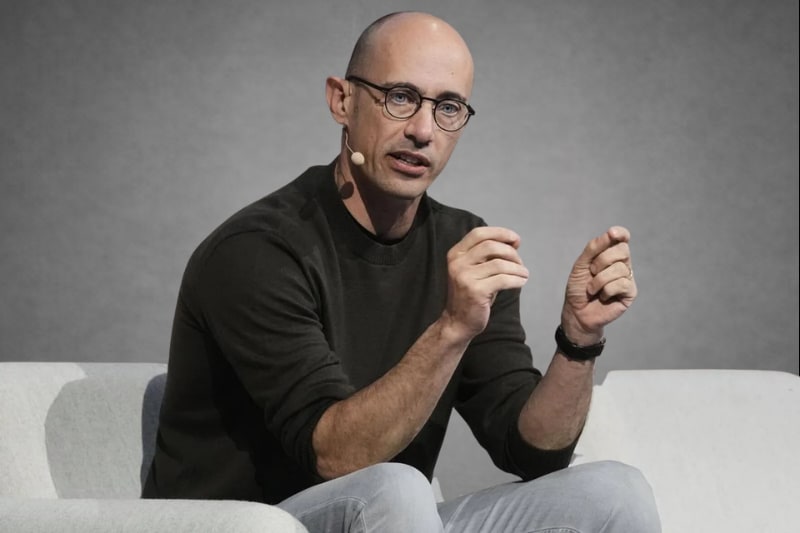
Chris Best, Co-founder & CEO at Substack
4.5/5 Rating
Technology
Not Publicly Disclosed /mo
Not Publicly Disclosed ARR

Chris BestCo-founder & CEO

In this interview, Substack co-founder and CEO Chris Best discusses the challenge of AI slop, the premium on human attention, and Substack's new transparency tooling. Best shares insights on the rise of generated long-form content, the integration of Pangram text detection, and the dynamics of co-writing with large language models. He critiques platforms that automate authorship, applying economic models like Baumol's cost disease to predict how value shifts when content production becomes free.

Chris Best

Chris Best

Co-founder & CEO

Substack

Substack

Founder Stats

  • Technology
  • Started 2017
  • Not Publicly Disclosed /mo
  • 100+ team
  • San Francisco, California, United States

About Chris Best

Chris Best is the co-founder and CEO of Substack, a subscription-based newsletter platform. Prior to co-founding Substack in 2017, he served as the co-founder and Chief Technology Officer of Kik Interactive, a mobile messaging application. Best is a graduate of the University of Waterloo, where he studied systems design engineering. He is a prominent voice in the creator economy, advocating for human-centric media systems and platform transparency.

Interview

July 23, 2026

Q

What is AI slop, and how does it define the foil for Substack?

Question 1 of 18
Chris Best

AI slop consists of generic, clickbait, and soulless content that nobody truly believes in. Substack exists to act as the foil to this trend, offering a platform where writers can create meaningful work they care about and earn a living doing so.

0
Q

What inspired you to address the rising presence of AI slop online?

Question 2 of 18
Chris Best

Over the past year, many people have felt inundated by automated content online. I noticed a growing feeling of frustration as a consumer, which led me to talk to Pangram Labs and discover that a large portion of professional writing is now machine-generated.

0
Q

What did Pangram's data reveal about long-form writing on LinkedIn?

Question 3 of 18
Chris Best

Pangram's measurements showed that approximately forty percent of long-form writing on LinkedIn was fully generated by artificial intelligence. While not all AI writing is low quality, this massive shift indicates that platforms must start offering transparency options.

0
Q

Why do you believe that AI slop operates like a denial of service attack on the public square?

Question 4 of 18
Chris Best

When the internet is flooded with automated text, readers have to constantly wonder if what they are reading is real. This makes it incredibly difficult to find new writers or discover original ideas, effectively shutting down constructive public discourse.

0
Q

How do you define the dividing line between responsible tool use and systemic gaming?

Question 5 of 18
Chris Best

I have no interest in policing the specific tools that creators use. The line is crossed when someone uses AI to game systems and generate thousands of posts without reviewing them, skipping the step of actually caring about or understanding the content.

0
Q

How does Substack's new Pangram integration help users navigate AI content?

Question 6 of 18
Chris Best

We integrated Pangram into the Substack app to allow readers to scan long-form text and check if it passed through an LLM. Writers can also add a statement explaining their creative process, encouraging open conversation rather than implementing rigid bans.

0
Q

What is "claudefishing," and why does it feel like a betrayal to readers?

Question 7 of 18
Chris Best

Claudefishing is a catfishing analogy where someone uses AI to respond to comments or write articles while presenting themselves as entirely human. It feels like a betrayal because it violates the expectation of a mutual investment of human attention.

0
Q

How does the Pangram tool estimate if a text was generated by a machine?

Question 8 of 18
Chris Best

Pangram works by identifying specific statistical distributions and word choices that large language models naturally favor. While it can be bypassed by advanced prompt engineering, it provides a transparent signal that helps writers and readers discuss authorship.

0
Q

How do you co-write with large language models using voice transcripts?

Question 9 of 18
Chris Best

I record a ten to fifteen minute voice transcript to get all my initial thoughts and personal style on the screen. The large language model takes this raw context and cleans up my verbal ticks while keeping the core thesis bold and intact.

0
Q

Why do you find yourself arguing with large language models during the drafting process?

Question 10 of 18
Chris Best

Large language models are cautious by nature and tend to water down original theses. I have to push the model to respect my original vision rather than smoothing it out, ensuring that the final draft remains as sharp and distinct as my thoughts.

0
Q

How does your writing process differ when you are struggling to find a concept?

Question 11 of 18
Chris Best

I use the model as a tennis wall to bounce ideas back and forth. I tell the AI that the thesis is not finished and list the directions I want to avoid. We iterate through seventeen drafts, using the tool to accelerate my thinking.

0
Q

Why do AI models have a default bias toward writing about ethics and governance?

Question 12 of 18
Chris Best

Reinforcement learning and safety training create a gravitational sync around certain concepts. For example, if you ask an AI to write about artificial intelligence, it will always include a section on ethics and governance even if you did not request it.

0
Q

How does the conceptual distribution of LLM ideas compare to human ideation?

Question 13 of 18
Chris Best

AI models represent an averaged out, central distribution of concepts, whereas human ideation has high variance and operates at the edges. The true value and human connection are found at the edges of the distribution, which AI struggle to replicate.

0
Q

Why does human attention remain the ultimate scarce resource in an AI-dominated world?

Question 14 of 18
Chris Best

As media becomes cheap and infinite, human attention becomes the only non-inflationary resource that cannot be artificially multiplied. The challenge for platforms is ensuring that when a human spends attention, they are receiving genuine value.

0
Q

How does Baumol's cost disease apply to writing when machine text becomes free?

Question 15 of 18
Chris Best

As the cost of generating standard text drops to zero, the value shifts entirely to things that cannot be automated, like authentic human experiences and relationships. Much like a live string quartet, the proof of human effort becomes the premium asset.

0
Q

Why does the Odyssey remain a powerful example of lasting human storytelling?

Question 16 of 18
Chris Best

The Odyssey has kept humanity debating and sharing perspectives for three thousand years. A great piece of writing is defined by its ability to spark long-term human conversations and build connections that ripple outward across generations.

0
Q

What features could Substack introduce to signal and reward high-quality, anti-slop ideas?

Question 17 of 18
Chris Best

Substack could build tools that highlight concepts and themes that are driving meaningful, high-context conversations. Highlighting these spiky, high-variance ideas acts as the opposite of slop detection, showing readers that original thought is valued here.

0
Q

How will the rise of sophisticated AI video affect creator platforms in the future?

Question 18 of 18
Chris Best

Video currently serves as a guarantor of human effort because it requires physical presence. However, as AI video avatars become indistinguishable from real humans, we will need to develop new cultural norms and expectations to prevent deceptive interactions.

0

Video Interviews with Chris Best

The AI Slop Problem Nobody's Talking About | Substack CEO Interview

The AI Slop Problem Nobody's Talking About | Substack CEO Interview

The AI Slop Problem Nobody's Talking About | Substack CEO Interview

Strong Values Matter More Than Pleasing Everyone | The Substack Story

Strong Values Matter More Than Pleasing Everyone | The Substack Story

Cite This Interview

Use this interview in your research, article, or academic work

Related Interviews

RJ Scaringe, Founder & CEO at Rivian
Technology

RJ Scaringe

Founder & CEO at Rivian

Approx. $460 Million
16000+

In this interview, Rivian founder and CEO RJ Scaringe discusses the company's journey from a clean-sheet startup to a leading electric vehicle manufacturer. Scaringe outlines…

Read Interview
Palmer Luckey, Founder at Anduril Industries
Technology

Palmer Luckey

Founder at Anduril Industries

Approx. $ 183.3 Million
7000+

In this interview, Anduril Industries founder Palmer Luckey discusses the company's culture and its rapid deployment of autonomous defense products like the Fury fighter jet.…

Read Interview
Prudhvi Raj Pakalapati, Co-Founder & CEO at Vector Technics
Technology

Prudhvi Raj Pakalapati

Co-Founder & CEO at Vector Technics

Approx. $0.48 Million
22+

In this interview, Vector Technics co-founder and CEO Prudhvi Raj Pakalapati discusses the company's expansion to a manufacturing capacity of 300,000 drone propulsion units annually.…

Read Interview
Peter Beck, Founder, President & CEO at Rocket Lab
Technology

Peter Beck

Founder, President & CEO at Rocket Lab

2600+

In this interview, Rocket Lab founder and CEO Peter Beck explains why acquiring Iridium is a transformational step toward building a fully vertically integrated space…

Read Interview
Sharad Kumar, Co-Founder & CEO at FluidCloud
Technology

Sharad Kumar

Co-Founder & CEO at FluidCloud

11–50

In this interview, FluidCloud co-founder and CEO Sharad Kumar explains why cloud portability is becoming a strategic priority as enterprises face outages, rising infrastructure costs,…

Read Interview
Neal Mohan, CEO at YouTube
Technology

Neal Mohan

CEO at YouTube

Approximately $4.5 Billion USD
7,000+

In this interview, YouTube CEO Neal Mohan discusses the future of the creator economy, YouTube's monetization model, AI-generated content, free speech, streaming competition, and the…

Read Interview