

Eric GlymanCo-Founder & CEOScaling Ramp to 2 Billion USD ARR and betting on the 100x AI employee
In this interview, Eric Glyman, Co-Founder and Chief Executive Officer of Ramp, breaks down how he scaled the financial operations platform to over two billion USD in annual revenue and a sixty billion USD valuation. He examines Ramp strategic bet on the one hundred times employee, the integration of autonomous agents into corporate finance, and the operational advantages of empowering super individual contributors. Glyman shares profound lessons on incentive alignment, software velocity, and building modern automated enterprises.


Founder Stats
- Finance
- Started 2019
- $166M/mo
- 200–1,000 employees
- New York City, New York, USA
About Eric Glyman
Eric Glyman is the Co-Founder and Chief Executive Officer of Ramp, the premier financial automation platform powering spend management, corporate cards, and accounts payable for tens of thousands of businesses. He previously co-founded Paribus, which graduated from Y Combinator and was acquired by Capital One. Under Glyman executive leadership, Ramp surpassed two billion USD in annual revenue, pioneering the deployment of autonomous financial agents across global enterprise operations.
Interview
November 20, 2026
What founding thesis drove you to launch Ramp after successfully selling Paribus to Capital One?
At Paribus, we built an automated agent that saved consumers money whenever prices dropped. When we looked at enterprise corporate cards, we realized the entire industry was built on misaligned incentives. Legacy card issuers made money by encouraging businesses to overspend so they could collect interchange fees. We founded Ramp on the contrarian promise of helping companies spend less time and less money.
How did Ramp scale from a simple corporate card to a sixty billion USD financial operations platform?
We expanded systematically from smart corporate cards into bill payment, procurement, travel booking, and automated expense reconciliation. Instead of forcing finance teams to stitch together five disparate software vendors, Ramp unified corporate spend into one intelligent platform. By delivering compounding operational efficiency that saved enterprises real dollars and hours, our platform evolved into the mission-critical financial nervous system for businesses.
What does Ramp strategic bet on the one hundred times employee mean in practice?
We believe artificial intelligence will not replace talented individuals, but rather amplify top performers into one hundred times operators. In the past, scaling an enterprise required adding layers of middle management and expanding headcount linearly. Today, a brilliant engineer, designer, or finance leader leveraging autonomous agents can produce the output previously requiring an entire department, fundamentally transforming organizational leverage.
How does Ramp integrate artificial intelligence agents directly into enterprise finance workflows?
Finance teams drown in manual receipt matching, invoice coding, and policy compliance audits. Ramp deploys autonomous agents that ingest messy documents, match receipts across bank feeds, extract line-item taxes, and flag out-of-policy expenses instantly. Agents handle ninety-five percent of repetitive clerical verification in the background, allowing finance directors to focus entirely on capital allocation and strategic growth.
Why does Ramp prioritize hiring super individual contributors over conventional management hierarchies?
Conventional corporate ladders reward people for accumulating headcount, which breeds bureaucracy and slows decision-making. We created compensation and career tracks that reward extraordinary individual contributors who remain close to code, product design, and customer problems. These super builders leverage modern tools to execute with unmatched speed, preserving our high-velocity startup culture even as revenue surpasses two billion USD.
How do you maintain software shipping velocity while managing billions in regulated financial transactions?
We maintain velocity through rigorous continuous integration and automated compliance safeguards. High velocity does not mean cutting corners on risk management or security. We automate verification protocols, run real-time fraud detection models, and give product teams autonomy to ship rapidly within well-defined guardrails. Speed and institutional security reinforce each other when engineering systems are properly architected.
What operational changes occur inside a software organization when engineers leverage agentic coding?
Engineers spend far less time writing routine boilerplate code and significantly more time architecting systems, reviewing edge cases, and understanding customer workflows. The definition of engineering shifts from typing syntax to directing intelligent systems. Our teams ship complex product modules in days that previously took quarters, dramatically accelerating our time to market across new financial products.
How does Ramp navigate competition from entrenched legacy financial institutions and tech incumbents?
Legacy banks possess enormous balance sheets but are handicapped by decades of decaying mainframe infrastructure and fragmented acquisitions. Incumbent software vendors treat software as a system of record that requires tedious manual data entry. Ramp wins because we build systems of intelligence that execute work automatically. When customers experience automated financial operations, they never go back to legacy manual tools.
What metrics should growth-stage software companies track to evaluate authentic artificial intelligence value?
Do not track vanity metrics like token consumption or chat interactions. Measure concrete operational throughput: hours of human labor saved, error rates eliminated, and cycle times compressed. If an artificial intelligence agent does not measurably reduce operational expenses or accelerate business turnaround times, it is merely entertainment. Real enterprise software value must show up definitively on the income statement.
How did your experience participating in Y Combinator shape your long-term founder mentality?
Y Combinator taught us the paramount importance of intense focus and relentless proximity to users. During our batch, the mantra was simple: build something people want and talk to users every single day. That foundational discipline remains embedded in Ramp DNA. Even at multi-billion-dollar scale, our executive team spends hours each week speaking directly with customers to identify operational friction.
What advice do you give second-time founders aiming to build category-defining enterprises today?
Pick a massive, structurally broken industry where market incumbents profit from customer inefficiency. Align your business model so that you only succeed when your customers succeed. When your economic incentives are totally aligned with customer value creation, customer retention becomes effortless, and word-of-mouth growth compounds into an unstoppable commercial flywheel over the long haul.
What is your expansive vision for the autonomous enterprise of the next decade?
We envision a future where companies operate with frictionless, autonomous financial back offices. Accounts payable, vendor procurement, tax compliance, and payroll will execute continuously with zero manual intervention. Eliminating financial administrative overhead will unleash human creativity, enabling lean teams of ambitious builders to build global enterprises that previously required thousands of employees.
Table Of Questions
Video Interviews with Eric Glyman
Ramp Bet on the 100x Employee - Y Combinator (Interview Video)
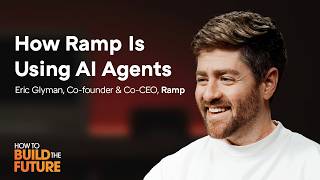
Ramp Bet on the 100x Employee - Y Combinator (Interview Video)

How Ramp Built A 60B USD AI Product Factory Off A Corporate Card - Co-CEO Eric Glyman

Eric Glyman - Hiring Super ICs at Ramp
Cite This Interview
Use this interview in your research, article, or academic work
Related Interviews

Bill Ackman
Founder & CEO at Pershing Square Capital Management
Concentrated value investing and building a compounding engine
In this interview, Bill Ackman breaks down his disciplined approach to concentrated value investing, explaining how structural market shifts from indexation and quantitative pods create…

Jason Cozens
Founder & CEO at Glint Pay
In this interview, Jason Cozens, founder and CEO of Glint Pay, joins Andy Schectman on Little by Little to discuss the resurgence of physical gold…

Tom Sosnoff
Co-founder & CEO at Lossdog
In this interview, Tom Sosnoff, co-founder of thinkorswim, tastytrade, and Lossdog, sits down with Will Stern in his Chicago studio to discuss forty-five years of…

Kevin Paffrath
Founder & CEO at Meet Kevin (Reinvest)
In this interview, Kevin Paffrath — financial analyst and creator behind the Meet Kevin brand — breaks down Alex Karp's controversial claim that OpenAI and…

Paul Graham
Co-Founder at Y Combinator
In this interview, Y Combinator co-founder Paul Graham reflects on twenty-one years of startup acceleration and forty-seven YC batches. Graham explores the nature of founder…

Sir Paul Marshall
Co-Founder, Chairman & CIO at Marshall Wace
In this interview, Marshall Wace co-founder and chairman Sir Paul Marshall discusses running a ninety billion USD alternative asset management firm. Marshall explains the synergy…