

Kevin PaffrathFounder & CEO
In this interview, Kevin Paffrath — financial analyst and creator behind the Meet Kevin brand — breaks down Alex Karp's controversial claim that OpenAI and Anthropic will need to be nationalized due to unlimited liability from intellectual property extraction. He explains Palantir's sovereign AI architecture, critiques Karp's fear-mongering as a 26-minute marketing play, and shares his own bullish position on Palantir stock based on its PEG ratio, pricing power, and revenue growth trajectory.

Founder Stats
- Finance
- Started 2018
- Not Publicly Disclosed/mo
- Not Publicly Disclosed team
- Ventura, California, USA
About Kevin Paffrath
Kevin Paffrath, known online as Meet Kevin, is an American YouTuber, financial analyst, real estate broker, and entrepreneur based in Ventura, California. He built one of the largest personal finance YouTube channels in the United States with several million subscribers and launched Reinvest, a financial analytics and membership platform accessible at meetreinvest.com. Paffrath is known for his high-frequency market commentary, stock analysis, and real estate investment content. He ran for Governor of California in 2021 and has expanded his brand into educational courses and investment tools.
Interview
September 23, 2026
What is Alex Karp actually claiming when he says OpenAI and Anthropic will be nationalized?
Karp's argument is that when you use a closed model and pay for tokens, the real reason those tokens are discounted is not to grow the market. It is to get access to your intellectual property so their models get better. There was functionally no honest disclosure of this. His claim is that these companies have exposed themselves to unlimited liability — both from enterprise clients whose IP was migrated without their knowledge, and from the broader global economy if those models contribute to destruction of value at scale. He says the only way you deal with that level of liability is to go to the government and give them 50 percent of your business. That is his nationalization thesis.
Do you believe that thesis?
No. I think it is convenient fear-mongering designed to sell Palantir products. Who gets a 26-minute segment on CNBC unless they are saying the world is going to end and the biggest AI companies are going to get nationalized and their investors are going to lose everything? That narrative got him the airtime. Palantir's pitch is essentially that you should use their sovereign AI approach instead of Claude or GPT because your data stays protected. That is a legitimate product pitch, but the doom framing is exaggerated.
What is Palantir's actual product and how does it differ from using Claude or GPT directly?
Palantir is arguing for a layered architecture they call sovereign AI. Rather than putting everything you have into a closed model that improves on your IP, Palantir builds an application layer on top of open-weight models or on-premise systems that you control. Their ontology layer sits between your data and the LLM. You get the intelligence without handing over your intellectual property to an external company. They have a lot of forward-deployed engineers who help clients set this up. It is a smart system. The fear-mongering is the marketing, but the underlying product is real.
You used a poker analogy. Can you explain that?
Karp said the first lesson in poker and in life is that if you think the other person is the mark, you are the mark. He was applying that to enterprise clients of OpenAI and Anthropic. These clients think they are getting discounted tokens because these companies want to grow the market. Karp says no, the enterprise clients are the mark. They are the ones giving away their IP. Their data trains the models, and now those models work against them. He is saying the investors in OpenAI and Anthropic are also the mark because they are funding a liability time bomb.
What does Palantir's financial picture actually look like right now?
The financials are genuinely strong. They have about 9.4 billion in free cash after paying around 500 million in operating costs. Revenue is up about 92 percent. Costs are only up 53 percent, so they have massive pricing power. The growth rate on Wall Street expectations is sitting around 47 percent annually. That gives them roughly a 23 PEG ratio right now, with a PE of about 109. My own forecast is closer to 50 percent growth over the next four years. At that rate, you could justify a three PEG, which puts this closer to a 250 dollar stock. I do not think it is fully priced.
What is the headless CRM threat that Karp is pointing to with Salesforce?
This is the clearest concrete example. Dario Amodei literally described at Dreamforce how executives at Anthropic now access all their Salesforce data just by talking to Claude. They do not log into Salesforce anymore. Claude pulls the deal data, win-loss probability, themes, all of it. So what happens to Salesforce's value proposition long term? That is what Karp calls the vampire effect. Claude is slowly extracting value from enterprise software companies by acting as the interface layer. Over time, you do not need the CRM. You just need the model. That is the market cap destruction Karp says will generate massive lawsuits.
Do you actually think the entire market could collapse the way Karp suggests?
No. That is the most extreme version of his argument and it took him about 12 minutes to get there, then one minute at the end to walk it back to the more reasonable point, which is that we cannot let China get ahead on AI. If you genuinely believed what he was saying in the first 12 minutes, you would not buy any stock at all. The fact that he is telling you to buy Palanteer in the same breath tells you that the doom scenario is marketing, not his actual belief.
What is your actual position on Palantir stock?
I like it. I bought it at 118 and I sent that buying alert to our alpha members at meetreinvest.com. I would still buy more at current prices because the fundamentals support it. The pricing power is exceptional, the balance sheet is strong, and they are highly selective with customers to the point where there is a waitlist. The arrogance you see from Karp is somewhat earned given the numbers. I just would not buy it because of the nationalization thesis. I would buy it because the PEG is reasonable for the growth rate.
What is the more important and credible point Karp actually makes?
The last point, not the first twelve minutes. The real conversation is about making sure Western democracies maintain AI dominance over China. Palantir's work with the US military gives them genuine credibility there. If you overregulate AI right now and slow down American labs, China gains ground. That is the serious geopolitical argument buried inside what started as a 26-minute doom advertisement. He gets there eventually, but it takes a while.
You mentioned Karp has a unique rhetorical style. How does it work?
It is what comedians do. They compliment someone in a very extreme way first and then deliver the punchline. Karp says Dario is brilliant, ethical, thoughtful. Then he says, but Dario is the mark and he does not even know it and he is going to get nationalized. The setup is the compliment. The punchline is the takedown. He did the same thing with the investors in OpenAI and Anthropic. He called them greedy, said they think the businesses are the mark, then flipped it and said no, you are the mark. It is effective rhetoric, but you have to recognize it for what it is.
What is the first lesson in poker and how does it apply to the AI investment landscape?
If you think the other person is the mark, you are the mark. Karp is applying this to everyone involved in the closed AI model ecosystem. The enterprise clients think they are getting a deal on tokens. The investors think the enterprise clients are the mark and that OpenAI and Anthropic are going to extract all the value. But Karp's argument is that the investors themselves are the ones who have made a mistake driven by greed. They did not mind when IP was migrating from every business into an entity they owned. They did not think through the next step, which is that value then migrates to the government. That is the poker lesson playing out at a macro scale.
What is the significance of Karp's timing in making these claims so close to the Anthropic IPO?
I do not think it is a coincidence that this is happening roughly a month before the Anthropic IPO. The framing is essentially buy Palantir instead of investing in Anthropic because Anthropic is going to get nationalized and go to zero. That is a very convenient message right before a competing company is about to raise a massive amount of public capital. It does not mean he is wrong about the product or the business fundamentals, but the timing tells you something about the strategic motivation behind going on CNBC and saying all of this in September 2026.
What does Palantir's whiteboard architecture actually consist of?
There are three distinct layers. The first is studying language and heuristics, which is the early Palantir approach to understanding unstructured data. The second is an ontology layer where data gets combined with algorithms and deterministic solutions. The third layer is where they now incorporate LLMs. Palantir calls the combination of these three layers sovereign AI. It is different from just calling the OpenAI API or using Claude directly because at no point in that stack does your raw proprietary data leave your environment. You are using the model as a tool rather than feeding the model as a training source.
How did CNBC anchor Sarah Eisen respond to Karp's arguments, and why does that matter?
She bit hook, line, and sinker. That is the most telling part of that entire interview to me. A sophisticated financial journalist sat there for 25 minutes and basically validated his framing. When he said that there are liability issues that make these companies uninsurable, she jumped in and said yes, that is going to drive a lot of liability. She became part of the marketing. That is how you know Karp is genuinely skilled at this. He did not just sell the narrative to retail investors watching YouTube. He sold it to the on-air talent at one of the most watched financial networks in the world. That is a 26-minute advertisement that cost him nothing.
What would it actually look like for the value of OpenAI or Anthropic to collapse in the nationalization scenario Karp describes?
According to Karp's logic it would happen in stages. First the business valuation collapses when you announce you are going to the government to hand over 50 percent of the company. Then it collapses again when government officials actually join the board because the alignment between commercial incentives and mission becomes impossible. Then it might collapse a third time across the broader market because these companies are so deeply embedded in the financial projections of hundreds of public companies that their failure becomes systemic. He is essentially describing a contagion scenario. I think that is deeply exaggerated, but if you take his premises at face value, that is the sequence.
You mentioned a coupon code called Worshes Balls at the end of the video. What is the broader point about how you monetize your content and investing analysis?
Look, I am a financial analyst who built his brand on YouTube. Part of what I do is be transparent about everything, including the weird stuff. The coupon codes, the alpha membership at meetreinvest.com, the Reinvest Terminal launching in November — that is all part of how this business works. I think being upfront about it is actually the more honest approach. I tell you I own Palantir stock before I tell you I think it is undervalued. I tell you there is a coupon expiring tomorrow. The alternative is to pretend you have no financial interest in what you are recommending, which is what a lot of people in this space do, and that is where you should be more skeptical, not less.
Table Of Questions
Video Interviews with Kevin Paffrath
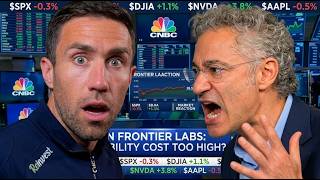
Palantir CEO Leaves CNBC SPEECHLES | UNHINGED INTERVIEW
Palantir CEO Leaves CNBC SPEECHLES | UNHINGED INTERVIEW

Why the AI Spending Bubble Could Collapse Overnight (Meet Kevin)
Why Palantir's CEO is Trying to Sabotage Anthropic's IPO (Meet Kevin)
Cite This Interview
Use this interview in your research, article, or academic work
Related Interviews

Paul Graham
Co-Founder at Y Combinator
In this interview, Y Combinator co-founder Paul Graham reflects on twenty-one years of startup acceleration and forty-seven YC batches. Graham explores the nature of founder…

Sir Paul Marshall
Co-Founder, Chairman & CIO at Marshall Wace
In this interview, Marshall Wace co-founder and chairman Sir Paul Marshall discusses running a ninety billion USD alternative asset management firm. Marshall explains the synergy…
Nigel Morris
Co-founder & Managing Partner at QED Investors
In this interview, QED Investors co-founder and Managing Partner Nigel Morris outlines the frameworks that built Capital One and QED Investors. Morris shares insights on…

Coen Jonker
Founder & CEO at Tyme Group
In this interview, Tyme Group CEO Coen Jonker discusses the platform's multi-country digital banking model across South Africa and the Philippines. Jonker explains how retail…

Bill Ackman
Founder & CEO at Pershing Square Capital Management
In this interview, Pershing Square Capital Management founder and CEO Bill Ackman discusses the current state of financial markets, highlighting the implications of artificial intelligence…

Emily Yuan
Co-founder & COO at Corgi
In this interview, Corgi co-founder and Chief Operating Officer Emily Yuan discusses the complexities of building an AI-native, full-stack commercial insurance carrier from scratch. Yuan…