
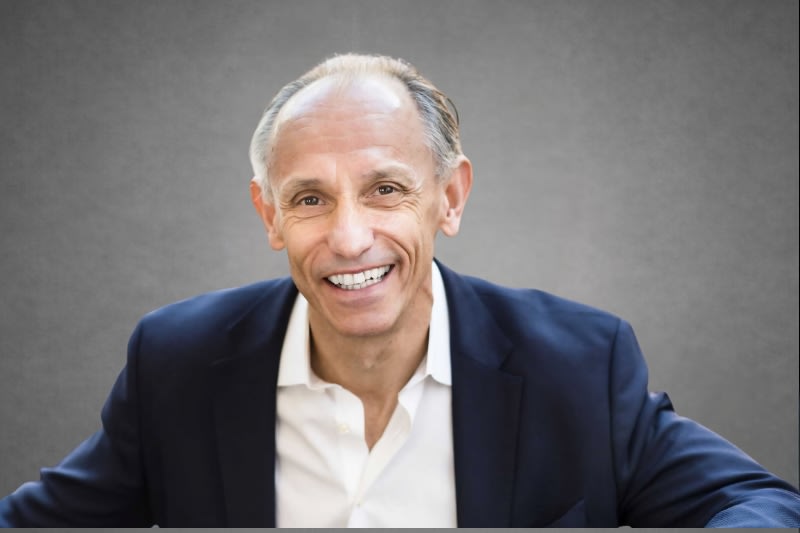
Nigel MorrisCo-founder & Managing Partner
In this interview, QED Investors co-founder and Managing Partner Nigel Morris outlines the frameworks that built Capital One and QED Investors. Morris shares insights on the importance of complementary leadership partnerships, describes QED's full ninety minutes philosophy of venture capital, and explains why incumbent banks fail to innovate. He also details the emergence of Nubank, the challenges of international fintech expansion, and the impact of generative artificial intelligence on financial services.

Founder Stats
- Finance
- Started 2007
- Not Publicly Disclosed/mo
- 50+ team
- Alexandria, Virginia, United States
About Nigel Morris
Nigel Morris is the co-founder and Managing Partner of QED Investors, a premier venture capital firm focused on financial services. He previously co-founded Capital One in 1994, pioneering a data-driven approach to consumer finance and risk-based pricing. At QED, Morris has backed many of the world's most successful fintech companies, including Nubank, Remitly, Credit Karma, and AvidExchange, leveraging his extensive operating experience to support founders through complex regulatory and strategic hurdles.
Interview
August 21, 2026
What inspired you to write down the ten most influential people in your life?
I wanted to reflect on the individuals who made a magnificent impact on me and changed the course of my life. Because four of the ten are no longer with us, I have committed to visiting the survivors this year and hunting down the children of the others to tell them how important their parents were.
How did transitioning from strategy consulting to general management change your leadership style?
In strategy consulting, being good at arithmetic and talking allowed you to keep up. But when I had to manage hundreds of customer service representatives at Signet Bank, I realized that consulting frameworks were not enough. I had to learn authentic leadership and work hard to become a real general manager.
What is the value of having a complementary partner in a high-growth company?
Surrounding yourself with people who complement you and whom you trust creates a team capability where the sum is greater than the parts. I had this relationship with Rich Fairbank at Capital One and Frank Rotman at QED. I will always choose a cohesive leadership team over a standalone charismatic CEO.
How did you handle the intense stress and doubt during the early days of Capital One?
There were days when the challenges felt horrendous and I suggested returning to consulting. Rich Fairbank reminded me that the darkest time is often just before the dawn. Having a trusted partner to remind you that things are never as bad as they seem during downturns, nor as good during highs, is invaluable.
Why did you set up dedicated playtime on Friday afternoons during your later days at Capital One?
As the company grew, I spent my time on earnings calls, regulatory meetings, and routine tasks that did not challenge my curiosity. To keep my sanity, I blocked out Friday afternoons for playtime, gathering with creative, technically subordinate individuals to pitch and explore wild ideas without any corporate pressure.
How did you protect your mental health to avoid burning out during your career?
Building a successful company takes ten to fifteen years of intense focus, and it is very easy to burn out. I protected my sanity by dedicating time to creative play and maintaining an incredibly strict, two-hour daily exercise routine. Coping mechanisms are essential to stay sane in a chaotic environment.
What key insights led to the founding of Capital One in 1994?
We noticed that insurance companies used risk-based pricing, charging higher premiums to reckless drivers. Credit cards in 1986 charged everyone a flat nineteen percent interest rate regardless of risk. We realized we could democratize access and improve economics by testing consumer behavior and pricing cards based on individual risk.
Why was the credit card industry in 1986 structurally ripe for disruption?
The industry was completely undifferentiated and lacked testing. Every bank offered the exact same product with no regard for customer risk profiles. High-risk customers were excluded, and low-risk customers were overcharged to subsidize others. This lack of risk-based pricing created a massive opportunity for an empirical, data-driven competitor.
How did your background in clinical psychology and statistics influence Capital One's testing model?
I became disillusioned with historical psychology because it felt more like philosophy than empirical science. I pivoted to statistics and experimental design. We realized that in a credit card business with millions of customers, we could treat every variable as an empirical test, utilizing A/B testing to observe consumer behavior.
How did you integrate marketing data and credit risk data at Capital One?
Credit people historically built metal detectors to filter risk, while marketing people looked at response rates. We integrated both. For example, two identical applicants applying at midday versus midnight carry different risk. The midnight applicant is often desperate, showing adverse selection. Marketing timing data is actually credit risk data.
Why did you decide to leave Capital One in 2004 despite its massive success?
We had grown Capital One into a twenty billion dollar public company operating in multiple countries, but the scale made the business slower and more bureaucratic. The entrepreneurial drive in me is a monster that requires constant creation. Waking up to manage a large corporation no longer satisfied my curiosity.
How did the operating principles of Capital One transition into QED Investors?
When we started QED, we received inbound inquiries from Capital One alumni seeking startup advice. We analyzed their ideas using our historical operating heuristics, such as testing customer response, measuring risk-based pricing, and calculating net present value. We realized that our deep operating experience was highly valuable to early-stage fintechs.
What is QED's full ninety minutes philosophy of venture capital?
The full ninety minutes refers to the length of a soccer match. Unlike VCs who write checks and pull back when a startup misses its numbers, we lean in during hard times. As former operators, we commit our time and resources to help founders navigate regulatory monsters, fraud management, and cash flow crises.
Why do you believe that incumbent banks are structurally bad at innovation?
Incumbent banks are optimized to avoid mistakes and grow at three percent a year, which makes their culture antithetical to venture-scale innovation. They suffer from the Galapagos effect, failing to partner with or acquire the agile fintech startups that could serve as their outsourced research and development engines.
What did you see in David Velez before he founded Nubank?
I met David when he was an associate at General Atlantic. He was an incredible listener, a sponge for information, and highly decisive. We spent weeks teaching him the Capital One model. He took those principles and elevated them by designing a mobile-first digital bank with a de minimis cost structure.
What are the biggest challenges facing international fintechs expanding into the United States?
Startups often try to expand internationally before launching a second product in their home market, which is usually a mistake. The United States is an incredibly sophisticated and competitive market. Furthermore, growth capital has dried up as the venture market has become completely intoxicated by artificial intelligence startups.
How is generative AI changing the cost structure and development speed of fintech startups?
AI is driving massive productivity gains. Code is now eighty percent written by machines, which lowers engineering costs. Call centers and repeatable manual processes are being digitalized through smart AI chat agents. Additionally, companies can now tailor marketing messages to individual customers at an n-equals-one scale.
Why is unit economics the single most critical system for evaluating fintech investments?
You can only build a profitable business one customer at a time. Evaluating overall ARR or EBITDA is secondary to measuring the horizontal economics of customer acquisition cost and net present value. A startup only achieves true vertical profitability through the cumulative addition of strong unit economics.
Table Of Questions
Video Interviews with Nigel Morris
Nubank's Strategy To Takeover USA | Nigel Morris | Olga Maslikhova | The J Curve Podcast

Nubank's Strategy To Takeover USA | Nigel Morris | Olga Maslikhova | The J Curve Podcast

ONE RULE Built A 20 Billion Company From 0
Cite This Interview
Use this interview in your research, article, or academic work
Related Interviews

Kevin Paffrath
Founder & CEO at Meet Kevin (Reinvest)
In this interview, Kevin Paffrath — financial analyst and creator behind the Meet Kevin brand — breaks down Alex Karp's controversial claim that OpenAI and…

Paul Graham
Co-Founder at Y Combinator
In this interview, Y Combinator co-founder Paul Graham reflects on twenty-one years of startup acceleration and forty-seven YC batches. Graham explores the nature of founder…
Sir Paul Marshall
Co-Founder, Chairman & CIO at Marshall Wace
In this interview, Marshall Wace co-founder and chairman Sir Paul Marshall discusses running a ninety billion USD alternative asset management firm. Marshall explains the synergy…

Coen Jonker
Founder & CEO at Tyme Group
In this interview, Tyme Group CEO Coen Jonker discusses the platform's multi-country digital banking model across South Africa and the Philippines. Jonker explains how retail…

Bill Ackman
Founder & CEO at Pershing Square Capital Management
In this interview, Pershing Square Capital Management founder and CEO Bill Ackman discusses the current state of financial markets, highlighting the implications of artificial intelligence…

Emily Yuan
Co-founder & COO at Corgi
In this interview, Corgi co-founder and Chief Operating Officer Emily Yuan discusses the complexities of building an AI-native, full-stack commercial insurance carrier from scratch. Yuan…