

Coen JonkerFounder & CEO
In this interview, Tyme Group CEO Coen Jonker discusses the platform's multi-country digital banking model across South Africa and the Philippines. Jonker explains how retail partnerships and automation reduce the cost to serve customers profitably, outlines the impact of stablecoins and artificial intelligence on their geographic expansion, and shares his insights on structural wealth patterns, financial inclusion, and the future of legacy banking.

Founder Stats
- Finance
- Started 2012
- Not Publicly Disclosed/mo
- 1900+ team
- Singapore
About Coen Jonker
Coen Jonker is the co-founder and CEO of Tyme Group, a multi-country digital banking group headquartered in Singapore. Jonker co-founded Tyme in 2012, leading its growth into a major player across South Africa and the Philippines. Formerly a human rights lawyer and bank executive, he holds an MBA and advocates for financial inclusion, technology-driven cost efficiency, stablecoins, and AI integration to serve underbanked communities globally.
Interview
August 14, 2026
What is the structure and presence of Tyme Group across different countries?
Tyme Group is a multi-country digital banking group headquartered in Singapore. We run fully regulated banks in South Africa and the Philippines, and fintech operations in Indonesia and Hong Kong. We also maintain a centralized technology hub with about eight hundred engineers and developers running out of Ho Chi Minh City in Vietnam.
What was the significance of Time magazine naming Tyme Group one of the most influential companies?
We were recognized not just for commercial success, but for the impact of our financial inclusion model. Through operating model innovation, we successfully reduced the cost of serving customers so that we can profitably serve even the poorest consumers. We also developed a unique crossover model that embeds banking in retail environments.
How does Tyme Group's retail partnership model help extend banking services?
We partner with fast moving consumer goods retailers, grocery stores, and pharmacies. This allows us to extend the frontiers of banking in emerging markets. Instead of relying on expensive bank branches, we place kiosks and services where consumers already shop, making banking highly accessible and cheaper to operate.
How did TymeBank become the first profitable digital bank in Africa?
We maintained a dogged focus on automation throughout the business to keep operational costs low. However, we also learned that you cannot build a sustainable, inclusive bank by serving only low-income customers. We expanded our services to mass affluent customers and built excellent credit lending capabilities to drive profitability.
How did shifting to an aspirational brand position help Tyme Group grow?
How are stablecoins and artificial intelligence shaping your expansion strategy?
Stablecoin platforms and artificial intelligence are hitting us like two tsunamis. They allow us to think differently about geographical expansion. Instead of entering one country at a time, we are exploring the opportunity to build the next version of our business as a multi-country, multi-currency digital solution.
What inspired you to transition from human rights law to digital banking?
Why do you believe that societal patterns of wealth and poverty are structural?
We grow up with a false narrative that how well people do is purely a function of individual talent and work ethic. While those are important, societal wealth patterns are structurally determined. The banking sector plays a massive role in either reinforcing these patterns or opening up opportunities for inclusion.
How does your morning boxing routine help you keep your warrior spirit alive?
Why do you believe payments and digital communications are the new economy's rails?
Payments and affordable internet data access are the foundational rails for emerging markets. We are at the foothills of a new payments revolution driven by decentralized finance. This revolution will lower transaction costs, speed up transfers, and enrich the transaction data that companies can utilize.
Why is it a concern that the global community has lost focus on financial inclusion?
There are still one billion people globally who are entirely excluded from the financial system. It is regrettable that the world's attention span has moved on from this generational problem. Small businesses also remain structurally undercapitalized in emerging markets, even though they act as the engine of the economy.
How does Tyme Group use artificial intelligence to reduce product development costs?
Do you think massive tech companies will eventually dominate the fintech space?
I doubt they will dominate completely. Large companies often believe they can do everything better, but they cannot beat a highly specialized team whose entire livelihood and wealth depend on doing one niche thing exceptionally well. The future belongs to hyperspecialization rather than massive centralized conglomerates.
Why is the dominance of US dollar denominated stablecoins a risk for other nations?
US dollar stablecoins have become a new way for the Federal Reserve to channel liquidity into the dollar, which threatens currency sovereignty. We should think about this risk more smartly. We need more private sector development of stablecoins denominated in trustworthy currencies like the Singapore dollar or Euro.
Why do you believe that bank branches have no future in modern finance?
Physical bank branches are extremely expensive to operate and create a high cost to serve, which structurally excludes lower-income customers. Digital banking, automated kiosks, and retail store partnerships are far more efficient channels to deliver financial services and represent the clear future of banking.
Why do you predict that Swift will not remain the primary tool for international money transfers?
International money transfers remain a major pain point due to high costs and slow processing speeds. Emerging technologies like stablecoins and decentralized finance rails offer faster, cheaper, and more secure alternatives. These new decentralized platforms will inevitably replace Swift's legacy rails over the next decade.
Table Of Questions
Video Interviews with Coen Jonker
Interview of 🔥Coen Jonker🔥 CEO & Founder Tyme Group
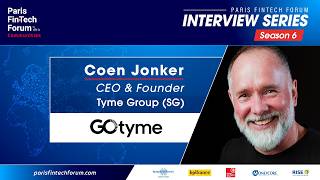
Interview of 🔥Coen Jonker🔥 CEO & Founder Tyme Group

What the FinTech? | S.6 Episode 10 | A brief history of Tyme Group with founder and CEO Coen Jonker

E01: What It Takes to Build a Digital Bank | Coen Jonker (Founder and Group CEO, Tyme Group)
Cite This Interview
Use this interview in your research, article, or academic work
Related Interviews

Kevin Paffrath
Founder & CEO at Meet Kevin (Reinvest)
In this interview, Kevin Paffrath — financial analyst and creator behind the Meet Kevin brand — breaks down Alex Karp's controversial claim that OpenAI and…

Paul Graham
Co-Founder at Y Combinator
In this interview, Y Combinator co-founder Paul Graham reflects on twenty-one years of startup acceleration and forty-seven YC batches. Graham explores the nature of founder…

Sir Paul Marshall
Co-Founder, Chairman & CIO at Marshall Wace
In this interview, Marshall Wace co-founder and chairman Sir Paul Marshall discusses running a ninety billion USD alternative asset management firm. Marshall explains the synergy…

Nigel Morris
Co-founder & Managing Partner at QED Investors
In this interview, QED Investors co-founder and Managing Partner Nigel Morris outlines the frameworks that built Capital One and QED Investors. Morris shares insights on…

Bill Ackman
Founder & CEO at Pershing Square Capital Management
In this interview, Pershing Square Capital Management founder and CEO Bill Ackman discusses the current state of financial markets, highlighting the implications of artificial intelligence…

Emily Yuan
Co-founder & COO at Corgi
In this interview, Corgi co-founder and Chief Operating Officer Emily Yuan discusses the complexities of building an AI-native, full-stack commercial insurance carrier from scratch. Yuan…