
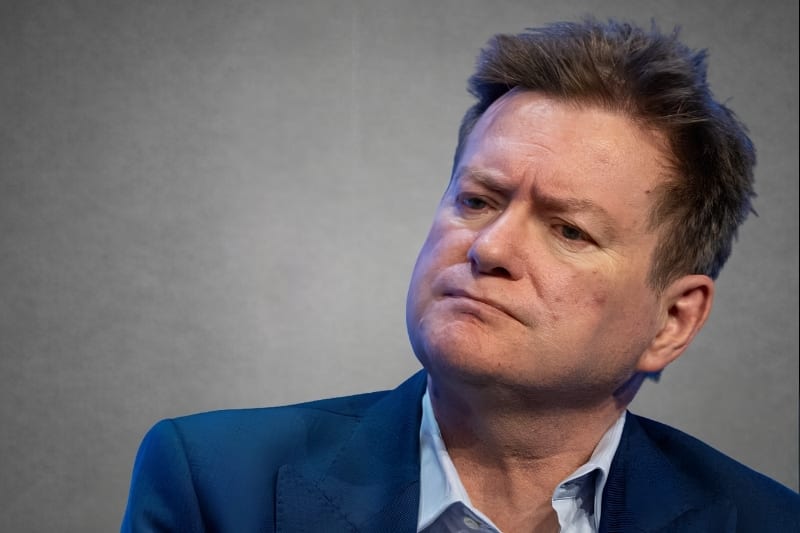
Sir Paul MarshallCo-Founder, Chairman & CIO
In this interview, Marshall Wace co-founder and chairman Sir Paul Marshall discusses running a ninety billion USD alternative asset management firm. Marshall explains the synergy between discretionary fundamental research and the proprietary TOPS alpha capture system, outlines how artificial intelligence and recursive self-improvement are transforming quant research, and analyzes market cycles and short selling dynamics. He also reflects on risk management failures, UK media investments, and educational philanthropy.
Founder Stats
- Finance
- Started 1997
- Not Publicly Disclosed/mo
- 750+ team
- London, England, United Kingdom
About Sir Paul Marshall
Sir Paul Marshall is the co-founder, chairman, and chief investment officer of Marshall Wace, a leading global alternative asset manager founded in 1997 with approximately ninety billion USD in assets. A pioneer in quantitative investing and alpha capture architectures, Marshall is also the author of 10 and a Half Lessons from Experience, co-founder of the education charity ARK, and an active investor in independent media.
Interview
September 03, 2026
What has enabled Marshall Wace to thrive for nearly three decades while many peer hedge funds have disappeared?
The key to our enduring success is relentless, continuous innovation. Many fund managers begin as smart balance sheet analysts, but firms often succumb to hubris by failing to maintain capital discipline as they scale. At Marshall Wace, we evolved from a traditional discretionary equity shop into an advanced technology firm that continually adapts our quantitative and systematic architectures.
How did the partnership between you and Ian Wace form the foundation of the firm?
Ian and I established the partnership in 1997 with complementary skill sets. Coming from proprietary trading, Ian brought a deep conviction in the transformative power of financial technology and built early algorithmic systems. In contrast, I contributed a fundamental analytical background. That balanced dynamic allowed us to pioneer European equity long-short strategies backed by initial seed capital from George Soros.
What were the origins and core mechanism behind the TOPS alpha capture application?
In 2002, we sought a scientific method to evaluate sell-side research commissions rather than relying on subjective voting. We built an intranet platform where global sales brokers ran virtual, intraday portfolios. The platform revealed immense actionable alpha, which we optimized, monetized, and transformed into our Trade Optimized Portfolio System (TOPS), blending algorithmic execution with quantitative signal processing.
How did Marshall Wace navigate the severe liquidity drawdowns during the 2008 global financial crisis?
During the 2008 crisis, our assets under management contracted from fourteen billion USD to three and a half billion USD because fund-of-funds clients faced broad liquidity shortages. While competitors gated investor redemptions, we honored every redemption without gating. Maintaining liquidity and market discipline preserved investor trust, enabling us to rebuild our institutional capital base on a significantly stronger foundation.
Why did Marshall Wace decide to sell a minority equity stake to KKR?
KKR approached us seeking a minority partnership that respected our operational autonomy. Selling a minority interest established a transparent market valuation for our internal equity partnership, incentivized senior talent, and provided institutional endorsement that accelerated our global capital formation across institutional pension and sovereign wealth allocators.
How does Marshall Wace combine discretionary fundamental analysis with systematic trading?
Our fundamental and systematic strategies operate in deep synergy. Fundamental managers leverage our quantitative infrastructure to distill vast market information overnight, while our quantitative strategies benefit from operating within an environment grounded in real-world market dynamics and balance sheet fundamentals rather than purely detached mathematical models.
How is artificial intelligence transforming quantitative and fundamental investing inside Marshall Wace?
AI has revolutionized fundamental research by providing contextual synthesis across filings, broker commentary, and alternative data. We have developed agentic portfolio systems where internal engineering models simulate specialized analyst competencies, moving toward recursive self-improvement where thousands of autonomous agents analyze data and refine trading signals around the clock.
Why does the combination of man plus machine consistently outperform pure machine systems?
While machines excel at processing massive datasets and automating earnings models, humans provide essential situational awareness and market intuition during unexpected volatility shocks. A skilled human manager understands regulatory shifts, institutional deleveraging flows, and market psychology, synthesizing quantitative signals with real-world macro context.
Why do you believe financial markets will remain inefficient despite advancements in computational processing?
Although pure information arbitrage has commoditized, analytical edges and behavioral inefficiencies persist. As generative AI tools empower retail traders, retail market participation increases across global exchanges. Retail trading flows frequently introduce emotional momentum and volatility, creating substantial structural alpha opportunities for disciplined institutional managers.
What makes short selling structurally more difficult and hazardous than long investing?
Short selling is fraught with structural hurdles because capital markets naturally tilt long. When a short position declines in value, position sizing expands against you, borrow fees can become exorbitantly expensive, and you compete against sophisticated hedge funds. However, successful shorting provides invaluable alpha and funds long growth positions.
What was your worst historical investment experience, and what risk management lesson did it impart?
My most severe career drawdown occurred during the 1990 Gulf War when I accumulated a massive long position in oil services equities ahead of military action. The subsequent market reaction severely damaged portfolio returns, teaching me a permanent lesson regarding the dangers of excessive single-theme concentration and the necessity of strict portfolio-level risk management.
How does Marshall Wace evaluate portfolio manager performance and instill humility?
Because top managers operate with a fifty-three to fifty-four percent win rate, accepting daily failure is intrinsic to investing. We evaluate managers using comprehensive analytics including win-loss ratios, slugging percentages, and sector alpha. We manage risk strictly at the portfolio level with formal drawdown constraints while cultivating a firm-wide culture of humility.
What specific personality traits do you look for when hiring future investment managers?
In an era where raw information is accessible to everyone, academic test scores matter less than high individual agency, deep intellectual curiosity, high stress tolerance, and constructive disagreeableness. We look for individuals who demonstrate original thinking, challenge consensus politely, and exhibit genuine passion through self-directed achievements.
What motivated you to establish the ARK education charity in the United Kingdom?
Driven by my Christian belief in the sacred equality of every human soul and the imperative of equal opportunity, we established ARK twenty-six years ago to turn around underperforming inner-city schools. Operating approximately fifty schools across disadvantaged regions in the UK, ARK applies rigorous operational standards to deliver outstanding academic outcomes.
Why did you choose to invest in independent media platforms like UnHerd, GB News, and The Spectator?
I entered media to challenge institutional groupthink and tribal journalism. Platforms like UnHerd and GB News were created to serve substantial audiences whose viewpoints were neglected by the traditional broadcast consensus, while The Spectator represents historic editorial excellence whose commercial operations benefit from modernized digital infrastructure.
What is your overarching outlook on macroeconomic cycles and the artificial intelligence revolution?
We are at the beginning of an unprecedented biological-scale Cambrian explosion in artificial intelligence and physical robotics that will drive massive productivity gains. While structural power constraints and chip demand are temporarily inflationary, the resulting technological leap will ultimately prove disinflationary and power an extended secular equity expansion.
Table Of Questions
Video Interviews with Sir Paul Marshall
Sir Paul Marshall: Why Markets Are Getting More Competitive | Podcast | In Good Company
Sir Paul Marshall: Why Markets Are Getting More Competitive | Podcast | In Good Company
Cite This Interview
Use this interview in your research, article, or academic work
Related Interviews

Bill Ackman
Founder & CEO at Pershing Square Capital Management
In this interview, Bill Ackman breaks down his disciplined approach to concentrated value investing, explaining how structural market shifts from indexation and quantitative pods create…

Jason Cozens
Founder & CEO at Glint Pay
In this interview, Jason Cozens, founder and CEO of Glint Pay, joins Andy Schectman on Little by Little to discuss the resurgence of physical gold…

Tom Sosnoff
Co-founder & CEO at Lossdog
In this interview, Tom Sosnoff, co-founder of thinkorswim, tastytrade, and Lossdog, sits down with Will Stern in his Chicago studio to discuss forty-five years of…

Kevin Paffrath
Founder & CEO at Meet Kevin (Reinvest)
In this interview, Kevin Paffrath — financial analyst and creator behind the Meet Kevin brand — breaks down Alex Karp's controversial claim that OpenAI and…

Paul Graham
Co-Founder at Y Combinator
In this interview, Y Combinator co-founder Paul Graham reflects on twenty-one years of startup acceleration and forty-seven YC batches. Graham explores the nature of founder…
Nigel Morris
Co-founder & Managing Partner at QED Investors
In this interview, QED Investors co-founder and Managing Partner Nigel Morris outlines the frameworks that built Capital One and QED Investors. Morris shares insights on…