
Nicholas Harris, Co-founder & CEO at Lightmatter
4.9/5 Rating
AI
Not Publicly Disclosed/mo
Not Publicly Disclosed ARR

Nicholas HarrisCo-founder & CEO

In this interview, Lightmatter co-founder and CEO Nicholas Harris explains how the company evolved from photonic computing to silicon photonics for AI networking. He discusses why data movement has become the primary bottleneck in modern AI infrastructure, how Lightmatter is scaling production with hyperscalers and chip companies, and why photonic interconnects will become the foundation of next-generation AI data centers powered by light rather than copper.

Nicholas Harris

Nicholas Harris

Co-founder & CEO

Lightmatter

Lightmatter

Founder Stats

  • AI
  • Started 2017
  • Not Publicly Disclosed/mo
  • 200+ team
  • Mountain View, California, USA

About Nicholas Harris

Nicholas Harris is the co-founder and CEO of Lightmatter, a silicon photonics company developing optical interconnect technology for AI infrastructure. A PhD graduate from MIT, Harris has spent his career advancing programmable photonics and high-performance computing. Under his leadership, Lightmatter has become one of the leading companies enabling next-generation AI data centers through photonic networking technologies and is now part of NVIDIA's NVLink Fusion ecosystem.

Interview

July 8, 2026

Q

What inspired you to start Lightmatter?

Question 1 of 12
Nicholas Harris

Lightmatter was founded in 2017 after recognizing that Moore's Law and Dennard scaling were no longer delivering the improvements needed for future computing. The original vision was to accelerate AI computation using light instead of electrical signals.

0
Q

Why did the company shift from photonic computing to photonic interconnect?

Question 2 of 12
Nicholas Harris

As transformer-based AI models became dominant, the main challenge moved from computation to moving massive amounts of data efficiently. The company pivoted toward solving networking bottlenecks with silicon photonics.

0
Q

What is the company's biggest priority today?

Question 3 of 12
Nicholas Harris

The immediate priority is delivering production chips for customers while scaling manufacturing and preparing silicon photonics for high-volume deployment.

0
Q

What makes manufacturing photonic chips especially challenging?

Question 4 of 12
Nicholas Harris

Unlike conventional semiconductors, photonic chips combine optical and electronic components. Testing and validating both systems simultaneously requires entirely new manufacturing processes.

0
Q

Why is light attractive for AI computing?

Question 5 of 12
Nicholas Harris

The physical behavior of light naturally performs mathematical operations like addition and multiplication, which are fundamental to neural networks. This enables significantly lower energy consumption compared to traditional electronics.

0
Q

Why is networking becoming more important than compute?

Question 6 of 12
Nicholas Harris

Modern AI systems rely on thousands of processors working together. Efficient communication between chips is now as important as the chips themselves, making networking a critical performance bottleneck.

0
Q

Who are Lightmatter's customers?

Question 7 of 12
Nicholas Harris

The company works with hyperscale cloud providers, GPU manufacturers, and custom AI chip developers that need advanced optical interconnect technology for large AI clusters.

0
Q

What is the Passage platform?

Question 8 of 12
Nicholas Harris

Passage is Lightmatter's photonic interconnect platform that integrates optics directly into AI hardware, enabling processors to communicate at extremely high bandwidth.

0
Q

What is a scale-up domain?

Question 9 of 12
Nicholas Harris

A scale-up domain is a tightly connected group of AI processors that communicate fast enough to function almost like a single chip, improving training and inference performance.

0
Q

Why are lasers important to the platform?

Question 10 of 12
Nicholas Harris

Photonic communication depends on laser technology. Lightmatter's GUIDE laser platform provides the optical source required for high-speed photonic links.

0
Q

How do AI data centers influence Lightmatter's roadmap?

Question 11 of 12
Nicholas Harris

As AI clusters continue growing, networking consumes an increasing share of system cost and power. Photonic networking becomes increasingly valuable as systems scale.

0
Q

Where does Nicholas Harris see the company in the next three years?

Question 12 of 12
Nicholas Harris

He expects silicon photonics to become mainstream inside AI infrastructure, with many leading AI models running on systems connected by Lightmatter's optical technology.

0

Video Interviews with Nicholas Harris

Exploring Lightmatter with Nicholas Harris, Founder & CEO: Powering AI at $4.4B Valuation

 Exploring Lightmatter with Nicholas Harris, Founder & CEO: Powering AI at $4.4B Valuation

Exploring Lightmatter with Nicholas Harris, Founder & CEO: Powering AI at $4.4B Valuation
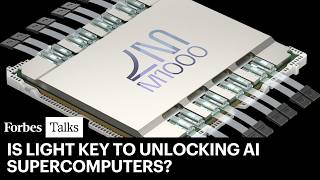
 Is Photonic Computing The Future Of AI Chip Technology?

Is Photonic Computing The Future Of AI Chip Technology?

Cite This Interview

Use this interview in your research, article, or academic work

Related Interviews

Jamie Stewart, Founder & CEO at Binq
AI

Jamie Stewart

Founder & CEO at Binq

Not Publicly Disclosed
6–20

In this interview, Jamie Stewart shares how he transitioned from an international music career into fintech entrepreneurship by founding Binq, an AI-powered business assistant for…

Read Interview
Mitesh Agrawal, Chief Executive Officer at Positron AI
AI

Mitesh Agrawal

Chief Executive Officer at Positron AI

Not Publicly Disclosed
70+

In this interview, Mitesh Agrawal explains how Positron AI is building purpose-built inference hardware to address AI's growing memory bottlenecks while competing alongside NVIDIA rather…

Read Interview
Alexander Caedmon Karp, Co-Founder & Chief Executive Officer at Palantir Technologies
AI

Alexander Caedmon Karp

Co-Founder & Chief Executive Officer at Palantir Technologies

Approximately US$135 million
4,400+

In this interview, Alex Karp explains why enterprise AI customers are demanding greater control over their data, models, and infrastructure. He argues that the future…

Read Interview
Michael Atalla, Chief Marketing Officer (CMO) at UiPath
AI

Michael Atalla

Chief Marketing Officer (CMO) at UiPath

Approximately $134 million
3,868

In this interview, UiPath Chief Marketing Officer Michael Atalla discusses how businesses are moving beyond AI experimentation and into large-scale implementation. He explains why the…

Read Interview
Faraj Aalaei, Founder & CEO at Cognichip
AI

Faraj Aalaei

Founder & CEO at Cognichip

Pre-revenue
50–100

In this interview, Faraj Aalaei explains how Cognichip is using Artificial Chip Intelligence (ACI) to transform semiconductor design. Drawing from decades of experience building chip…

Read Interview
Asparuh Koev, President & CEO at Transmetrics
AI

Asparuh Koev

President & CEO at Transmetrics

$1M+
50–100

In this interview, Transmetrics CEO Asparuh Koev discusses the practical realities of AI in logistics and trucking. He explains where AI delivers measurable value today,…

Read Interview