

Christopher LongFounder & CEOBuilding a High-Margin Industrial Outdoor Storage Business Renting Fenced Dirt
In this interview, Christopher Long, Founder and CEO of Longyards, reveals how he pioneered an industrial outdoor storage business renting fenced land to commercial contractors. He explains why bare dirt storage avoids the crushing capital expenditure of traditional warehouses, how supply-constrained municipal zoning creates durable pricing power, and how creative seller financing enabled him to scale multiple profitable yards while working just five hours per week.



Founder Stats
- Retail
- Started 2019
- $35K/mo
- Under 10 employees
- Buffalo, New York, USA
About Christopher Long
Christopher Long is the Founder and CEO of Longyards, an industrial outdoor storage company providing secure fenced land for contractors, equipment operators, and transport fleets. Originally a commercial general contractor who experienced acute yard shortages firsthand, Long launched his first facility in 2019. He successfully scaled Longyards across multiple North American markets, generating substantial monthly cash flow with minimal physical infrastructure overhead.
Interview
November 26, 2026
What inspired you to leave general contracting and build an outdoor storage business?
As a commercial contractor managing fourteen employees, I experienced immense stress dealing with slow-paying clients, complex building permits, and thin profit margins. When I needed secure parking for our work trailers and heavy excavators, every local storage facility turned me away. I realized that thousands of tradespeople faced the exact same bottleneck. Renting secure fenced parcels of land solved an acute operational problem with vastly superior economics.
How does industrial outdoor storage differ financially from conventional indoor self-storage?
Traditional indoor self-storage requires millions of dollars in vertical building construction, HVAC climate systems, and continuous interior maintenance. With industrial outdoor storage, you purchase vacant industrial land, grade the surface, install secure security fencing, and add automated keyless gate access. Because capital expenditure remains exceptionally low, our profit margins are significantly higher and our operational breakeven threshold requires only a fraction of total lot capacity.
How do you source and acquire prime industrial land parcels using creative seller financing?
Many owners of vacant industrial land are retired contractors or passive family estates who face heavy capital gains taxes if they sell outright. We approach these property owners directly and offer structured seller financing terms. By offering reliable monthly interest payments secured by the underlying real estate, we acquire prime commercial land with minimal upfront capital while providing the seller with dependable passive retirement income.
What specific customer types drive recurring tenancy across your storage facilities?
Our tenant base is heavily weighted toward business-to-business commercial contractors. We serve utility operators, roofing companies, electrical contractors, landscaping fleets, and regional tow truck operators. These commercial clients rely on our yards daily to safeguard expensive commercial vehicles, machinery, and material trailers. Because our location is essential to their daily operations, commercial tenants pay reliably and exhibit exceptionally long retention cycles.
How do you overcome municipal zoning hurdles when establishing new outdoor storage locations?
Municipalities often view vacant dirt lots with skepticism because they fear disorganized junkyards or noise pollution. We overcome municipal hesitation by presenting professional site plans featuring commercial grade fencing, high-definition security cameras, manicured gravel surfaces, and automated lighting. By positioning our facilities as orderly, secure contractor storage hubs that support local trade businesses, we secure municipal permits far faster than speculative industrial developers.
What operational automation allows you to manage multiple yards working five hours weekly?
We run our facilities as completely unstaffed digital properties. Prospective tenants tour the lot virtually, complete automated background checks, sign digital lease agreements, and receive an instant smartphone gate access credential. Automated billing software processes credit card payments on the first of every month and automatically revokes gate access if an account becomes delinquent. Eliminating on-site managers minimizes administrative overhead and human error.
How does the dual-appreciation dynamic enhance the long-term wealth creation of outdoor yards?
Industrial outdoor storage acts as a lucrative land-banking strategy. While the facility produces reliable monthly cash flow from commercial tenant leases, the underlying real estate appreciates continuously as metropolitan boundaries expand. As prime industrial parcels become scarcer due to municipal rezoning for residential housing, the intrinsic value of our land escalates. Investors capture ongoing cash flow yield while simultaneously holding an appreciating physical asset.
How do you determine optimal lease pricing across different vehicle and equipment footprints?
We divide our acreage into standardized stall dimensions customized for work vans, extended utility trailers, and oversized semi-trucks. Rather than charging arbitrary flat rates, we analyze local commercial warehouse rents and price our outdoor spaces at a substantial discount compared to indoor square footage. This positioning offers contractors compelling cost savings while allowing us to maximize aggregate monthly revenue per acre of land.
What was the most challenging operational mistake you made when opening your initial yard?
On our first flagship property, we underestimated the importance of heavy-duty ground stabilization. Heavy commercial flatbeds and loaded dump trailers quickly created deep ruts in wet soil during rainy seasons. We had to invest additional capital to install geotextile fabric and compacted recycled asphalt base. Ensuring proper surface drainage and ground stability from day one prevents costly site remediation and protects customer vehicles.
How do you handle security enforcement and prevent abandoned equipment on your properties?
Strict tenant verification and active perimeter surveillance are mandatory. We require all prospective tenants to provide commercial business registrations, vehicle titles, and valid insurance before granting lot access. High-definition cloud cameras monitor every gate entry and perimeter fence line around the clock. Our digital lease agreements specify that any unauthorized or abandoned machinery will be impounded immediately, maintaining a clean and secure professional environment.
What economic advantages make outdoor storage resilient during broader macroeconomic downturns?
During economic recessions, contracting businesses downsize expensive office leases and warehouse spaces to conserve cash. However, contractors still require secure local parking for their revenue-generating work trucks and equipment. Our low-cost outdoor parcels become the natural recipient of businesses shedding expensive commercial rent. The essential utility of physical equipment parking shields our properties from the severe vacancies that hurt premium office parks.
What core advice do you give to first-time entrepreneurs evaluating industrial real estate?
Stop believing that you must construct massive complex buildings to build substantial real estate wealth. Look for unglamorous, overlooked assets where customer demand heavily outstrips existing supply. Drive around your city, identify vacant industrial parcels sitting idle near major highways, and reach out directly to the owners. Simple businesses with low structural overhead consistently produce the most dependable long-term financial freedom.
Table Of Questions
Video Interviews with Christopher Long
Forget Storage Units. He Rents Out Empty Dirt Instead?! - UpFlip (Interview Video)
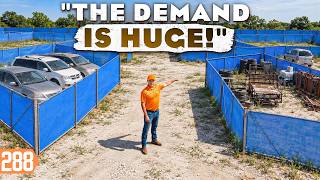
Forget Storage Units. He Rents Out Empty Dirt Instead?! - UpFlip (Interview Video)

How Industrial Outdoor Storage Makes 35K USD per Month - UpFlip

Bootstrapping Fenced Land Storage for Commercial Fleets - Longyards
Cite This Interview
Use this interview in your research, article, or academic work
Related Interviews

Patrick Elston
Founder & Owner at Gus Franco's Pizza
Building a 35K USD monthly artisan pizzeria from home popups to wood-fired brick
In this interview, Patrick Elston, Founder and Owner of Gus Franco's Pizza, shares how he turned a backyard wood-fired pizza hobby into a thriving artisan…
Jim Rowe
Founder & CEO at Black Diamond Resale
Turning liquidation returns and excess inventory into high-margin retail cash fl
In this interview, Jim Rowe, Founder and Chief Executive Officer of Black Diamond Resale, shares how he pivoted from a twenty-five-year restaurant career into building…

Marco Palmieri
Founder, Chairman & CEO at Piquadro
Industrializing Italian leathercraft and revitalizing heritage luxury brands
In this interview, Marco Palmieri, Founder and Chief Executive Officer of Piquadro, traces his entrepreneurial trajectory from selling handmade leather bags from his car trunk…
Ronnie Fieg
Founder, CEO & Creative Director at Kith
In this interview, Ronnie Fieg, founder, CEO, and creative director of Kith, opens up 15 years of his brand's archive and shares stories he has…

Jake Karls
Co-founder & Chief Rainmaker at Mid-Day Squares
In this interview, Mid-Day Squares co-founder and Chief Rainmaker Jake Karls describes the unconventional journey of building a disruptive snack brand. Karls shares insights on…

Matt Ebert
Founder & CEO at Crash Champions
In this interview, Crash Champions founder and CEO Matt Ebert discusses the growing demand for skilled trades and the automotive technician shortage facing the collision…