

Jamie DimonChairman & CEO
In this interview, JPMorgan Chase Chairman and CEO Jamie Dimon discusses navigating macroeconomic tail risks, managing corporate bureaucracy, and building long-term financial resilience. Dimon addresses global deficits, rejects doomerism regarding AI job displacement, and evaluates the potential of Starlink data centers in space. He shares details on JP Morgan's Security and Resiliency Initiative, explains why character and empathy define successful leadership, and reflects on surviving near-fatal health crises.

Founder Stats
- Finance
- Started 1799
- Approx. $15 Billion/mo
- 32000+ team
- USA
About Jamie Dimon
Jamie Dimon is the Chairman and CEO of JPMorgan Chase, the largest bank in the United States. Born in New York City, Dimon studied at Tufts University and Harvard Business School. He began his career at American Express, later building Citigroup, and took the helm of JPMorgan Chase in January 2006. Dimon guided the firm through the 2008 financial crisis without posting a quarterly loss and is recognized as a leading global voice in finance and economic policy.
Interview
July 24, 2026
This is interview 2 of 2 with Jamie Dimon.
Jamie Dimon has been featured on CEO Insider 2 times. Explore the full collection.
Can JPMorgan Chase sustain the historically high quarterly profits of 21.2 billion USD?
We are currently in an environment of high volumes and high asset prices that is almost as good as it gets for banking. While this environment can continue for a while, it will eventually end. We run the bank for the long term, focusing on client service and investing through thick and thin rather than chasing short-term profit peaks.
What tectonic geopolitical developments could suddenly disrupt the global market?
There are several complex geopolitical risks that are not fully baked into market expectations. These include the war in Ukraine, conflicts and terrorism in the Middle East, rising global deficits, remilitarization, and America's relationship with China. These tectonic plates can interact in unpredictable ways to cause significant market shocks.
How did the global economy show such resilience against oil price spikes and supply disruptions?
The adjustment was remarkable because the global economy is highly diversified and less reliant on energy as a component input. When we lost twenty million barrels a day, China cut back and drew down reserves, and the U.S. did the same. While this diversification provides resilience, tipping points in history are often triggered by a concurrence of multiple unforeseen events.
Should the U.S. government intervene economically or militarily to prevent Iran from obtaining nuclear weapons?
Preventing Iran from obtaining a nuclear weapon is a matter of global survival. We must separate existential national security from short-term economic metrics like gas prices. A president should be honest with the American people and apply severe, coordinated economic pressure to resolve this threat, even if it leads to temporary economic friction.
What is the goal of JPMorgan's Security and Resiliency Initiative?
The initiative aims to address the Western world's dangerous over-reliance on potential adversaries for critical resources like rare earths, semiconductors, and active pharmaceutical ingredients. We are organizing big corporations, venture capital, and vendors to secure local supply chains across drones, cyber, space, APIs, and defense production.
Why do you believe that high global deficits will eventually become a serious economic problem?
Debt-to-GDP ratios are at one hundred percent across the U.S. and Europe, with deficits hovering around five to six percent during good economic times. Historically, these numbers only occurred during depressions or wars. If we do not address this maturely, the bond vigilantes will eventually rattle the market and drive interest rates higher.
Would you personally buy long-dated government bonds at current interest rates?
Personally, I would not buy long-dated government bonds. Even if inflation drops to two percent, the ten-year bond yield should naturally sit around four to four and a half percent. Having studied economic history, I remember how inflation climbed steadily after the 1974 recession, and I do not see the upside in buying bonds today.
Why are you optimistic about the long-term returns on corporate AI investments?
AI is a real, transformative technology that will help cure cancers, prevent medical errors, and invent new drugs. Like the internet, the total corporate investment in AI will pay off, but it will not pay off on the exact timeline or in the way that people expect. We are already finding cheaper, automated ways to run models.
Why do you reject doomerism regarding AI eliminating human jobs?
What is the potential of SpaceX's Starlink project for space-based data centers?
Space-based data centers are technically viable and offer massive advantages, including very cheap solar energy, natural cooling, and structural stability free from planetary vibrations. Starlink's network of thousands of lasers can transmit data back to Earth and reroute signals dynamically around bad weather.
Did JPMorgan Chase face a real threat of bankruptcy during the 2008 financial crisis?
No, there was zero chance of JP Morgan going bust. We maintained far more capital and liquidity than our peers. I had been doing stress tests since 2004, assuming a worst-case scenario where every business unit failed simultaneously. This conservative planning ensured we were prepared to handle the crisis.
How did you grow JPMorgan Chase eight-fold without setting size as a target?
Chasing size gets banks into trouble. I focused on daily execution, branch networks, and systems, modeled after athletes who master their craft. We remained critical of ourselves, admitting when competitors like Goldman or Stripe outperformed us in specific areas, and focused on rapid recognition of errors to fix mistakes.
Is it lonely to make massive, high-risk corporate decisions like acquiring Bear Stearns?
Yes, it is lonely. Even with extensive due diligence and an army of experts checking loans and trades, the final call is yours. When the board votes and you sign the paper, you know you have committed one hundred and fifty thousand employees to backbreaking work and put your shareholders under pressure. That realization creates a pit in your stomach.
Why has JPMorgan's headcount decreased in New York while growing in Texas?
Headcount follows economic attractiveness and where employees want to live. New York has dropped from thirty-five thousand to twenty-six thousand employees, while Texas has grown from eleven thousand to thirty-five thousand. Municipalities must compete on taxes, housing, transit, schools, and overall quality of life to retain major corporate employers.
Why do you oppose special bank levies like the three percent extra corporate tax in the UK?
It is unprincipled to punish healthy companies that did not cause the financial crisis. JP Morgan is a great citizen in the UK, hiring veterans, training workers, and providing medical coverage. Special bank taxes have cost our shareholders five billion dollars, which ultimately discourages capital formation and drives companies to delist from London.
How do you combat complacency, bureaucracy, and arrogance in a massive organization?
Combating bureaucracy requires active leadership. I conduct road trips and branch visits, giving tellers and managers beer and immunity to tell me what is broken in our systems. A leader must be relentlessly curious, read customer complaints, and remain willing to learn from competitors and mistakes.
Why is CEO insecurity a major driver of corporate failure and poor advice?
When executives get promoted, they often know very little about the new departments reporting to them. Insecure leaders try to hide their lack of knowledge by surrounding themselves with sycophants who tell them what they want to hear. A secure leader welcomes criticism and is not embarrassed to admit they have a poor product.
How did surviving throat cancer and an aortic dissection shape your view on life?
Surviving throat cancer and emergency open-heart surgery left me with no major regrets. I realized I was leaving behind a great family and a strong company. It reinforced my focus on the present moment, keeping me relentlessly organized so that I can dedicate my weekends and vacations entirely to my family.
Table Of Questions
Video Interviews with Jamie Dimon
Jamie Dimon: My Lessons for Leaders

Jamie Dimon: My Lessons for Leaders

amie Dimon: Why I Won't Buy Bonds, AI's Future & Leadership Lessons
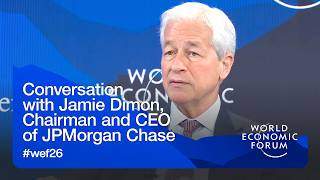
Conversation with Jamie Dimon | WEF Annual Meeting 2026

JPMorgan Chase CEO Jamie Dimon speaks at Reagan National Economic Forum
Cite This Interview
Use this interview in your research, article, or academic work
Related Interviews

Bill Ackman
Founder & CEO at Pershing Square Capital Management
In this interview, Bill Ackman breaks down his disciplined approach to concentrated value investing, explaining how structural market shifts from indexation and quantitative pods create…

Jason Cozens
Founder & CEO at Glint Pay
In this interview, Jason Cozens, founder and CEO of Glint Pay, joins Andy Schectman on Little by Little to discuss the resurgence of physical gold…

Tom Sosnoff
Co-founder & CEO at Lossdog
In this interview, Tom Sosnoff, co-founder of thinkorswim, tastytrade, and Lossdog, sits down with Will Stern in his Chicago studio to discuss forty-five years of…

Kevin Paffrath
Founder & CEO at Meet Kevin (Reinvest)
In this interview, Kevin Paffrath — financial analyst and creator behind the Meet Kevin brand — breaks down Alex Karp's controversial claim that OpenAI and…

Paul Graham
Co-Founder at Y Combinator
In this interview, Y Combinator co-founder Paul Graham reflects on twenty-one years of startup acceleration and forty-seven YC batches. Graham explores the nature of founder…
Sir Paul Marshall
Co-Founder, Chairman & CIO at Marshall Wace
In this interview, Marshall Wace co-founder and chairman Sir Paul Marshall discusses running a ninety billion USD alternative asset management firm. Marshall explains the synergy…