

Mo GharbatFounder & CEO
In this interview, Mo Gharbat, Founder and CEO of Open, discusses building an enterprise artificial intelligence customer communication platform that replaces legacy support systems. He breaks down their land-and-expand deployment strategy, the operational mechanics behind automating seventy-seven percent of financial communications, overcoming enterprise skepticism toward automated agents, cultivating relentless team intensity through customer obsession, and how self-building software models will reshape the future of enterprise software.

Founder Stats
- AI
- Started 2024
- Not Publicly Disclosed/mo
- 6–20 team
- Middletown, Delaware, United States
About Mo Gharbat
Mohammad Mo Gharbat is the Founder and CEO of Open, an artificial intelligence customer communication engine automating enterprise support and engagement workflows. Backed by Y Combinator in the Winter 2024 batch, Gharbat previously served as a software engineer at European fintech giant Mollie and engineering team lead at MENA ecommerce leader Zid. Under his leadership, Open achieved rapid enterprise adoption across financial institutions, automating over seventy-seven percent of customer interactions.
Interview
October 16, 2026
What is Open, and how does the platform automate customer communications for large enterprises?
Open operates as an artificial intelligence customer communication engine designed for large enterprises. We partner with major institutions such as banks and financial services firms to automate their customer-facing communication channels, spanning customer support, outbound messaging, and proactive outreach. If an enterprise communicates directly with its customer base, Open provides the intelligence layer and workflow automation to manage and execute that interaction end to end.
How does Open integrate into legacy enterprise infrastructure without requiring complex system migrations?
Large enterprises rely on established legacy platforms such as Salesforce or Zendesk and cannot pause operations for long migration periods. Open layers directly on top of their existing software infrastructure. This non-invasive integration allows clients to go live within thirty days without altering their core workflows or migrating databases. Once implemented, the system immediately automates roughly seventy-seven percent of routine communications while preserving operational continuity.
What is the typical expansion trajectory once Open goes live within an enterprise organization?
We operate through a disciplined land-and-expand approach. We initially deploy to automate primary tier-one customer support inquiries. After proving value, we expand to automate proactive communications and intricate multi-party coordination workflows. By month three, we introduce omnichannel voice and telephony automation. Within eight months of proven reliability, enterprises typically retire their legacy help desks completely and standardize entirely on Open.
Why do complex financial institutions struggle to scale customer support operations using human agents alone?
Financial institutions deal with communication that is simultaneously complex, high volume, and mission critical. Because customer conversations involve personal finances, mistakes carry severe consequences. Onboarding human agents in these environments takes up to six months of specialized training. Open alleviates that operational bottleneck by executing routine resolutions instantly, maintaining uniform accuracy across all channels, and freeing human staff to focus on intricate advisory duties.
What were the greatest technical hurdles your engineering team faced while constructing the Open platform?
A common misconception in the industry is that assembling an artificial intelligence agent is trivial. While generating basic responses is straightforward, building the surrounding operational harness, multi-channel orchestration, and reliable enterprise integrations requires immense effort. Our initial team of four engineers spent an entire year living and working in two rooms to construct the complete platform architecture, ensuring it could withstand enterprise security, compliance, and volume standards.
What is your thirty-day proof of outcome model, and why does it achieve a ninety-five percent conversion rate?
Rather than running conventional, unstructured proof-of-concept trials, we offer a thirty-day risk-free proof of outcome. Within the first two weeks, we configure and deploy the customer's initial automated workflows. The client spends the remaining two weeks running live production traffic through the system. If the platform fails to meet performance benchmarks, they walk away without financial commitment. This risk-reversal framework consistently delivers over a ninety-five percent conversion rate.
What primary catalysts prompt high-growth enterprises to seek out Open's communication engine?
Enterprises usually reach out during inflection points when rapid customer growth outstrips human hiring capacity across support and sales. Other clients possess sufficient hiring capital but want to deliver high-touch, personalized service to millions of customers simultaneously. Standard legacy tools cannot deliver individualized interactions at scale, driving leadership teams to implement automated systems that enable round-the-clock conversational engagement.
How do you address corporate skepticism stemming from past disappointments with legacy chatbots?
Many prospective buyers carry negative memories of early rule-based bots that degraded user satisfaction. We demonstrate that modern large language model systems represent a genuine qualitative upgrade. In live enterprise benchmarks, our autonomous agents consistently score ten percent higher in customer satisfaction metrics than human representatives. Demonstrating superior accuracy and rapid resolution times quickly dispels historical skepticism.
Across voice, text, and chat channels, which communication mediums are experiencing the fastest adoption?
Text-based channels including WhatsApp, web widgets, and email still represent the vast majority of total volume due to their convenience and low barrier to entry. However, voice AI is our fastest-growing medium month over month. While text handles immediate volume, enterprise telephone interactions carry immense operational cost, making voice automation the primary frontier for operational transformation.
How did you acquire the domain name open.cx, and how did it influence your branding strategy?
Early on, our business went through several unwieldy domain iterations like openchat.us and openmobile.us. Because Open is such a common word, organic discoverability was difficult. We searched domain availability on Namecheap and discovered open.cx listed for only 1,000 USD, far below typical premium valuations of 10,000 USD or more. We acquired the four-letter domain immediately and executed a complete brand consolidation around customer experience.
What is the fundamental key to successfully automating corporate knowledge and customer interactions?
Successful automation requires clear, rigorously documented internal procedures already followed by human teams. Many organizations mistakenly believe they must invent separate knowledge repositories specifically for artificial intelligence. In reality, models succeed by digesting the exact operational instructions and policy documentation that human agents use. If internal documentation produces excellent human outcomes, automated agents will replicate and exceed those results.
What will enterprise customer support look like in five years as artificial intelligence agents mature?
Within five years, human customer support queues will become obsolete. As autonomous models continue to refine accuracy and speed, end users will expect instant, comprehensive resolutions. Calling a business and being routed to a human representative will be viewed as an inconvenience because it implies hold times and manual lookup delays. Enterprise customer communication will be managed almost entirely by intelligent software systems.
How did four engineers onboard twenty global enterprises without a dedicated marketing or sales team?
We achieved early enterprise scale through relentless, high-touch customer obsession. Our four engineers managed technical onboarding, customer integration, and support calls at all hours of the day and night. We operated without outbound marketing or dedicated sales personnel, driving growth entirely through inbound referrals and reputation. When enterprise buyers experience flawless execution and exceptional attention, word of mouth scales the business rapidly.
Why do you believe conventional advice about targeting narrow niches is outdated in the artificial intelligence era?
Traditional startup playbooks advise founders to solve a tiny, isolated pain point before expanding. Modern artificial intelligence platforms break that assumption because enterprise buyers desire cohesive platforms that consolidate fragmented stacks rather than another point solution. The communication challenge spans support, outbound sales, and marketing. Building a comprehensive, intuitive super-app that consolidates disparate vendors provides far greater enterprise utility.
What core lessons did your team absorb from participating in Y Combinator twice?
Y Combinator instills extreme operational intensity. The program conditions founders to eliminate distractions, execute with relentless focus, work long hours, and maintain single-minded commitment toward customer satisfaction and product velocity. That intense operational culture became embedded across our entire team, allowing us to outmaneuver legacy incumbents with a fraction of their headcount.
How do you anticipate self-building and self-healing software models transforming the enterprise SaaS landscape?
Software will transition from static feature menus toward self-building systems. Historically, users waited months for engineering teams to build custom feature requests. Emerging models allow users to describe missing functionality through natural language prompts, enabling the platform to generate and deploy custom workflows automatically against foundational data structures. Enterprise software will become inherently adaptable and self-extending.
Table Of Questions
Video Interviews with Mo Gharbat
How Mo Gharbat Created and Scaled Open.cx (AI Customer Support Platform)
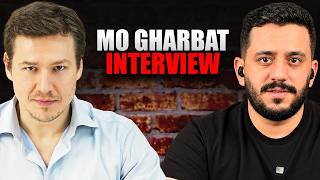
How Mo Gharbat Created and Scaled Open.cx (AI Customer Support Platform)
Cite This Interview
Use this interview in your research, article, or academic work
Related Interviews

Sam Altman
Co-founder & CEO at OpenAI
In this interview, Sam Altman discusses the accelerating pace of artificial intelligence, the realities of preparing OpenAI for a public offering while preserving its nonprofit…

Sravanth Aluru
Co-Founder & CEO at Avataar
In this interview, Sravanth Aluru breaks down the architectural shift toward AI-native enterprises, arguing that organizations must deploy a central intelligence layer rather than relying…

Jensen Huang
Co-founder & CEO at NVIDIA
In this interview, Jensen Huang, co-founder and CEO of NVIDIA, sits down with Anderson Cooper to address the most urgent questions surrounding AI safety, autonomous…

Noah Shinn
Founder & CEO at Instinct
In this interview, Noah Shinn, founder and CEO of Instinct, breaks down what a personal AI agent actually means in practice, how the product is…

Diogo Almeida
Co-Founder & CEO at TypeSafe AI
In this interview, Diogo Almeida, co-founder and CEO of TypeSafe AI, breaks down why the industry has been building the wrong kind of AI for…

Anton Oika
Co-Founder & CEO at Lovable
In this interview, Anton Osika, co-founder and CEO of Lovable, explains why the era of vibe coding is over and the era of serious AI-powered…