

Sundar PichaiCEO
In this interview, Google and Alphabet CEO Sundar Pichai discusses how AI is reshaping Google, search, software development, and the future of work. He shares his leadership approach, explains Google's AI strategy, reflects on organizational change, and offers his perspective on AGI, innovation, and the responsibilities that come with building one of the world's most influential technologies.

Founder Stats
- Technology
- Started 2015 or
- $1M+/mo
- 50+ team
- USA
About Sundar Pichai
Sundar Pichai is the CEO of Google and Alphabet. Since joining Google in 2004, he has helped lead products including Chrome, Android, and Search, and now oversees Google's transformation into an AI-first company while guiding its long-term technology strategy.
Interview
9 June, 2026
This is interview 2 of 2 with Sundar Pichai.
Sundar Pichai has been featured on CEO Insider 2 times. Explore the full collection.
How do you think about Google's structure today?
How has AI changed the way Google operates?
What did the ChatGPT moment teach you as a leader?
What is your approach to making decisions?
How do you know when a decision deserves extra attention?
What role do leaders play in an AI-driven company?
Great leaders remain incredibly important. Technology can improve efficiency, but people still provide vision, judgment, and accountability. Different organizations require different structures, but I don't see leadership becoming less important. If anything, leaders become more important as technology becomes more powerful.
How is AI changing the way employees work?
Could AI eventually replace CEOs?
How do you think about the future of AI agents?
What is your vision for Google's AI assistant?
Why do you think many people feel anxious about AI?
Is public concern about AI just a marketing problem?
What responsibility do technology companies have as AI advances?
How do you see the future of the web?
What does it mean to be in the "foothills of the singularity"?
Table Of Questions
Video Interviews with Sundar Pichai
How Sundar Pichai is rethinking Google for the AI era | Decoder
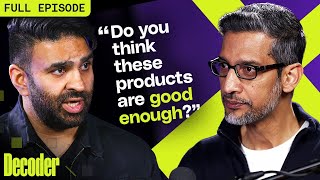
How Sundar Pichai is rethinking Google for the AI era | Decoder
AGI in 3 or 5 Years No Longer Matters — Pichai Lays Google's Cards Bare | The Verge Interview
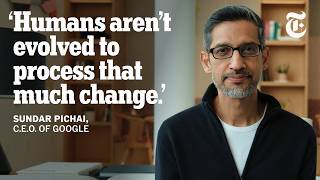
Sundar Pichai on A.I. Backlash, the Future of Work and Google’s Next Era
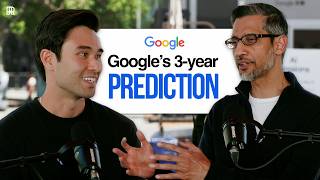
Sundar Pichai on Agents Replacing Engineers, Google's Future, AI's Flip Phone Moment, and More
Cite This Interview
Use this interview in your research, article, or academic work
Related Interviews

Jake Cooper
Founder & CEO at Railway
In this interview, Jake Cooper, Founder and CEO of Railway, details how the cloud platform scaled to nearly 100 million USD in annual recurring revenue…

Kai Yu
Founder & CEO at Horizon Robotics
In this interview, Dr. Kai Yu, founder and CEO of Horizon Robotics, sits down with Nicolai Tangen, CEO of the Norwegian Sovereign Wealth Fund, to…

Irena Pereira
Founder & CEO at Unleashed Games
In this interview, Irena Pereira, CEO of Infinite Realms and founder of Unleashed Games, explores how gaming can solve the global loneliness epidemic. Drawing on…

Vineet Nayar
Former CEO at HCL Technologies
In this interview, Vineet Nayar, former CEO of HCL Technologies, challenges conventional ideas about managing people, the role of Indian IT in the AI era,…
Tobi Lütke
Founder & CEO at Shopify
In this interview, Tobi Lütke, founder and CEO of Shopify, shares how AI agents and a company-wide culture shift are reshaping the future of work.…

Larry Ellison
Co-Founder, Executive Chairman & CTO at Oracle
In this interview, Oracle co-founder, executive chairman, and CTO Larry Ellison explores his five-decade journey building one of the world's most formidable enterprise software giants.…