
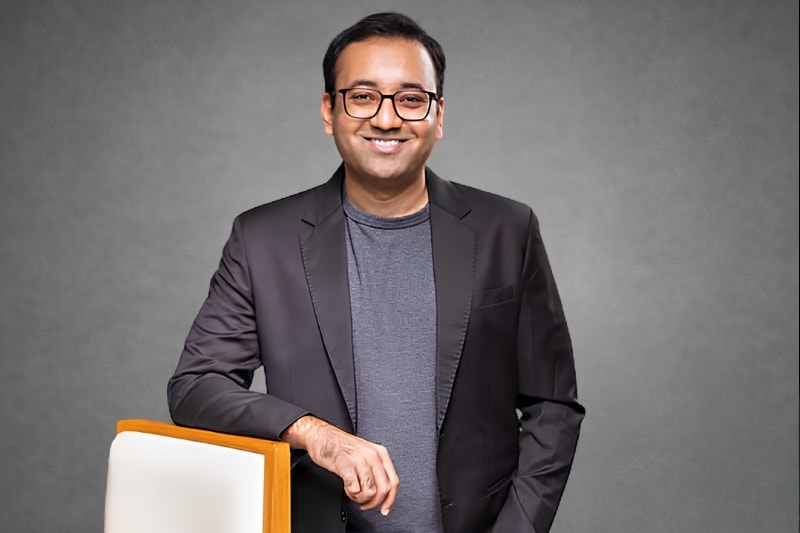
Tarun MehtaCo-Founder & CEO
In this interview, Ather Energy co-founder and CEO Tarun Mehta reflects on building India's premier electric two-wheeler enterprise from an experimental college project into a publicly listed manufacturing powerhouse. Mehta details how an early battery demo unexpectedly became the Ather 450 scooter, discusses navigating severe capital scarcity before their initial public offering, and explains why engineering-led differentiation and open-source charging standards enabled them to outcompete legacy automotive giants.

Founder Stats
- Production
- Started 2013
- Approx. USD 22 Million/mo
- 3500+ team
- Bengaluru, Karnataka, India
About Tarun Mehta
Tarun Mehta is the co-founder and CEO of Ather Energy, a pioneering Indian electric vehicle manufacturer established in 2013. An engineering graduate of IIT Madras, Mehta spearheaded the development of the Ather 450 and Rizta electric scooters, India's proprietary fast-charging infrastructure, and advanced battery management architectures. His relentless focus on deep-tech innovation and full-stack vehicle engineering has positioned Ather Energy at the forefront of India's clean mobility revolution.
Interview
September 15, 2026
This is interview 2 of 2 with Tarun Mehta.
Tarun Mehta has been featured on CEO Insider 2 times. Explore the full collection.
How did an initial ambition to become a corporate consultant evolve into founding an electric vehicle company?
Early on, I followed a conventional path focused on high grades, engineering college, and chasing lucrative corporate consulting packages. However, a student entrepreneurship trip to Stanford exposed me to early-stage founders building real companies, which ignited my desire to build tangible hardware. That experience convinced me that building physical products in the energy sector offered far deeper purpose than comfortable corporate golden handcuffs.
How did your collegiate project on Stirling engines lead to developing EV battery packs?
My co-founder Swapnil Jain and I spent years experimenting with Stirling engines powered by ambient heat. While those early experiments did not yield a commercial company, they solidified our commitment to the clean energy space. After graduating, I filed a patent on battery pack architecture for electric cars, quickly realizing that India's urban traffic dynamics made electric two-wheelers a far more viable and urgent market.
What pivotal realization convinced you and Swapnil Jain to transition from batteries to building a complete scooter?
We initially set out to be an energy and battery supplier for other vehicle manufacturers. We built a prototype scooter simply as a functional demo to showcase what our battery pack could deliver. When prospective customers evaluated the prototype, nobody inquired about battery chemistry; they fell in love with the ride experience of the scooter itself. We realized the core market bottleneck was the absence of a well-engineered consumer vehicle.
Why did Ather choose to develop a full-stack vehicle in India rather than importing Chinese components?
Importing off-the-shelf components was impossible because Chinese electric scooters were engineered purely as low-speed, last-mile utility vehicles designed to support municipal public transit. In India, where professionals across all income brackets navigate congested city streets on two-wheelers, consumers demanded highway speeds above sixty kilometers per hour and premium build quality. We were forced to design every single component from scratch in India.
What made raising early venture capital so exceptionally difficult for Ather in 2014?
In 2014, institutional venture capitalists in India were focused entirely on asset-light consumer internet startups and refused to back capital-intensive automotive hardware. It took eighty investor pitches to secure our first angel investment of twenty-five lakh rupees, followed by eighty more meetings to raise our subsequent round. Our cap table was built on angel backers, strategic investors, and late-stage sovereign wealth funds rather than traditional venture capital.
How did recruiting formula student race-car engineers give Ather an early operational advantage?
We deliberately recruited passionate student engineers who had built race cars in collegiate Formula Student competitions. For these young engineers, joining Ather meant continuing to build cutting-edge physical vehicles in state-of-the-art facilities while earning a salary. Their passion generated near-zero employee attrition across our first four hundred hires, giving us the cultural stamina to endure grueling hardware development cycles.
What humbling lessons did you learn from designing the exterior scooter aesthetic before solving the internal packaging?
We initially froze the aggressive exterior styling of the scooter to protect the consumer design language, assuming our engineering team could package components inside any shape. That decision cost us fifteen months of painful delays as we wrestled with electromagnetic interference, heat dissipation, manufacturing constraints, and service accessibility. It taught us a permanent lesson in balancing ambitious aesthetics with rigorous automotive packaging realities.
How did Ather 450 achieve early success despite high initial production costs and single-source suppliers?
On paper, the initial rollout of the Ather 450 was financially irrational. The unit cost was nearly 3.7 lakh rupees while we retailed it at 1.2 lakh rupees, our factory produced only twelve units weekly, and our supply chain relied on single vendors. However, because the riding dynamics, digital dashboard, and performance were materially superior to anything in the market, early adopters evangelized the product and gave us the momentum to scale manufacturing.
How did Ather establish its own competitive hill instead of attacking legacy two-wheeler incumbents directly?
Attempting to compete directly against multi-billion-dollar automotive giants like Hero, Honda, and TVS on distribution or manufacturing scale would have been suicidal. Instead of attacking their established hills, we built our own hill grounded in proprietary software, battery engineering, and digital user experiences. We forced legacy competitors to build electric vehicle programs to respond to our technological standards.
How did you manage the dynamic of having Hero MotoCorp as both a major strategic shareholder and a market competitor?
From the outset, we agreed that Ather would remain completely independent with founders in executive control. While Hero acquired an approximate thirty percent equity stake and subsequently launched its own Vida electric platform, our platform architectures and target demographics were distinct. Competition is ultimately defined by product strength and consumer affinity rather than boardroom spreadsheets.
What persistent financial pressures pushed Ather toward pursuing a public stock market listing?
Hardware development requires massive recurring capital outlays. From 2016 onward, we rarely operated with more than twelve months of cash runway in the bank. Recognizing that private venture capital markets exhibited investor fatigue toward capital-intensive manufacturing, our mentor Sachin Bansal advised us that public markets offered the only sustainable route for discovering fair valuation and securing long-term expansion capital once our revenues surpassed fifteen hundred crore rupees and gross margins became profitable.
How did drafting the draft red herring prospectus and pitching over one hundred institutional investors reshape your narrative?
Writing the draft red herring prospectus forced our leadership team to articulate our business fundamentals with complete mathematical clarity. During our IPO roadshow, presenting our core pitch deck to one hundred and ten institutional investors over two grueling months refined our corporate narrative, forcing us to prove how our proprietary technology directly drives operating margins and commercial defensibility.
How do you balance long-term automotive hardware research against the quarterly expectations of public markets?
Managing public expectations is fundamentally an exercise in transparent corporate storytelling. Investors understand that multi-year hardware research cannot interrupt daily production. Founders must demonstrate disciplined daily operational metrics—optimizing manufacturing throughput, lowering bill-of-materials costs, and expanding retail market share—proving that running one factory efficiently guarantees that scaling to ten plants will be equally profitable.
What defining legacy do you hope the Ather 450 leaves on India's electric mobility transition?
I hope the Ather 450 is permanently remembered as the vehicle that destroyed the myth that electric two-wheelers were fragile plastic toys. By outperforming conventional petrol scooters in acceleration, handling, and connectivity, it proved that electric powertrains were superior and forced India's legacy automotive giants to take electrification seriously.
How did Ather succeed in establishing its proprietary charging connector as the national standard for two-wheelers?
Rather than keeping our fast-charging architecture proprietary, we open-sourced the design and offered it royalty-free to the entire industry. We collaborated with the Bureau of Indian Standards to formalize our connector as the Light Electric Combined Charging System (LECCS), creating a unified national charging standard and proving that Indian engineering can define global technical benchmarks.
What advice do you offer to deep-tech founders attempting to raise venture funding for physical hardware in India?
Deep-tech hardware lacks simple recurring software metrics, making fundraising inherently difficult. Founders must translate physical engineering milestones—moving from an initial benchtop prototype to an integrated beta mule—into quantifiable derisking metrics that investors can evaluate. With rising capital flows and national pride in domestic manufacturing, there has never been a better time to build physical deep-tech in India.
Table Of Questions
Video Interviews with Tarun Mehta
How Ather Energy Stood Against All Odds | Ft. Tarun Mehta

How Ather Energy Stood Against All Odds | Ft. Tarun Mehta
Ather Energy | Tarun Mehta on Engineering, Scale and India's Tech Future
'25-50% Of Industry Is In This Price Segment': Ather's Tarun Mehta
Cite This Interview
Use this interview in your research, article, or academic work
Related Interviews

Simon Baloyi
President & CEO at Sasol
In this interview, Sasol president and CEO Simon Baloyi discusses the operational turnaround of the global integrated chemicals and energy company. Baloyi details cross-functional collaboration…
Tarun Mehta
Co-Founder & CEO at Ather Energy
In this interview, Ather Energy co-founder and CEO Tarun Mehta discusses the evolution of India's electric two-wheeler market and the unveiling of the EL platform…

Peter Beck
Founder & CEO at Rocket Lab
In this interview, Rocket Lab founder and CEO Sir Peter Beck discusses the company's evolution from a rocket launch startup into an integrated space systems…

Dr. Frank-Steffen Walliser
Chairman & CEO at Bentley Motors
In this interview, Bentley Motors Chairman and CEO Dr. Frank-Steffen Walliser discusses the engineering, craftsmanship, and design philosophy behind high-performance luxury cars. Walliser explains why…

Ronnen Harary
Co-founder & Board Chair at Spin Master
In this interview, Spin Master co-founder Ronnen Harary discusses building a global toy empire, the power of entrepreneurship, and overcoming learning disabilities. Harary shares the…

Warwick Smith
CEO at American Pacific Mining Corp.
Warwick Smith is the CEO of American Pacific Mining, a U.S.-focused copper and gold exploration company. With over 25 years in the mining industry, he…