

Fred ThielChairman and CEO, MARA Holdings
In this interview, Fred Thiel discusses MARA’s power-first strategy for building long-term value in Bitcoin mining and digital infrastructure. He explains how market selloffs are often amplified by leverage, large holders, and shifting investor sentiment. Thiel also shares why access to low-cost energy, flexible infrastructure, and operational optionality positions miners to benefit from both Bitcoin growth and the rising demand for AI computing.

Founder Stats
- Cryptocurrency, AI, Technology, Finance
- Started 2010
- $1M+/mo
- 50+ team
- USA
About Fred Thiel
Fred Thiel is the Chairman and CEO of MARA, one of the largest digital asset and Bitcoin mining companies in North America. With decades of experience in technology, infrastructure, and public company leadership, he has guided MARA’s expansion beyond mining into energy and computing infrastructure. His leadership focuses on operational efficiency, strategic asset allocation, and capitalizing on emerging opportunities across Bitcoin and artificial intelligence.
Interview
December 20, 2025
You said the market felt frothy. What made you say that?
What do you think really triggered the November weakness in Bitcoin?
How do older whale wallets impact market psychology?
Why does leverage make selloffs feel worse than fundamentals?
In a risk off environment, Bitcoin operates a lot like equity in portfolios today. Then you see layered strategies and highly leveraged positions unwind. People pile into short trades on perpetual markets, and when the move goes against them, forced unwinds add more selling pressure on top of everything.
How do you see liquidity and macro policy shaping next year?
How do you lead through uncertainty like shutdowns and weak data?
When miners look at AI, what is the big risk you see?
Borrowing against Bitcoin to invest in AI can be a challenging situation. If Bitcoin price is depressed, those profiles can go negative and it causes issues. Miners should stay focused on mining Bitcoin, then leverage the assets they already have and convert them into higher value options carefully.
What are the main paths miners can take to enter AI?
What is MARA’s approach to AI compared to peers?
Why is private cloud a core requirement for inference AI?
Your BTC holdings rose, but you also started selling production. How do you balance that?
Why aren’t you cutting hash rate to fund an AI pivot?
We are certainly not cutting back our hash rate. Global hash rate has not slowed down much, except recently when older equipment shut down after price drops. Many peers are converting capacity they have not brought online yet, or building green field sites, not necessarily ripping out running sites.
How do you explain mining profitability tightening even with high prices?
What is the operations lesson on energy costs and hosted models?
What does your near zero cost energy strategy look like in practice?
What is the institutional investment thesis for a miner now that ETFs exist?
Many investors value us close to the value of our Bitcoin holdings, and mining can get little attribution in market cap. But savvy investors look at our sites and power pipeline. The biggest constraint in AI is power, and the fastest way to get power is converting a mining site, so optionality matters.
What are your next major milestones, and how do you stay focused?
Closing the Exaion investment after regulatory approval and finalizing the MPLX deal are key, and we expect both in Q1. We also have international steps like Saudi and France footprints. The focus is treating land and power as a portfolio of assets and maximizing value across Bitcoin and inference AI.
Table Of Questions
Video Interviews with Fred Thiel
Bitcoin Miners Dumping BTC? MARA CEO Fred Thiel On AI Pivot And Market Selloff

Bitcoin Miners Dumping BTC? MARA CEO Fred Thiel On AI Pivot And Market Selloff
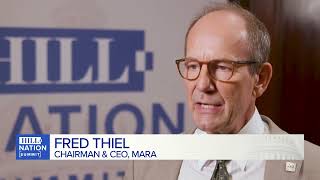
Fred Thiel, CEO of MARA, at the Hill Nation Summit: Bitcoin & Mining

Fireside Chat: Fred Thiel & Patrick J. Witt | MARA Government Affairs
Cite This Interview
Use this interview in your research, article, or academic work
Related Interviews

Naveen Rao
VP of Generative AI & Former CEO of MosaicML at Databricks
In this interview, Naveen Rao, VP of Generative AI at Databricks and former CEO of MosaicML, analyzes the explosive economics of artificial intelligence inference and…
Rahul Vohra
Founder & CEO at Superhuman
In this interview, Rahul Vohra, Founder and CEO of Superhuman, explores why superficial AI integrations fail to retain software users and outlines frameworks for embedding…

Sam Altman
Co-founder & CEO at OpenAI
In this interview, Sam Altman, Co-Founder and CEO of OpenAI, explores the practical trajectory toward artificial general intelligence and the imperative of human agency in…
Mike Cannon-Brookes
Co-Founder & CEO at Atlassian
In this interview, Mike Cannon-Brookes, Co-Founder and CEO of Atlassian, discusses the practical integration of autonomous AI agents across modern enterprise collaborative workflows. He examines…

Jensen Huang
Co-founder & CEO at NVIDIA
In this interview, Jensen Huang, Founder, President and CEO of NVIDIA, addresses prevailing existential narratives surrounding artificial intelligence and outlines Europe's sovereign computing opportunities. He…

Aneel Bhusri
Co-Founder & CEO at Workday
In this interview, Aneel Bhusri, Co-Founder and CEO of Workday, unpacks the seismic impact of enterprise AI agents on global corporate labor and organizational architecture.…